

E-commerce CRO Made Easy: Tools and Tips to Switch Skyrocket!
Conversion optimization for e-commerce website success is no longer about driving traffic, but about turning visitors into paying customers.
With rising customer buying costs and increasing competition across global markets, e-commerce brands in the USA and worldwide are focusing on conversion rate optimization (CRO) to maximize every click, session, and interaction.
Many online stores struggle with common challenges like high cart abandonment rates, low checkout completion, and poor user experience (UX design).
Even with strong marketing campaigns, without proper optimization, a large percentage of potential revenue is left untapped.
Powerful CRO tools and data-driven strategies come into play, helping businesses understand user behavior, identify friction points, and improve the overall shopping journey.
Conversion optimization for e-commerce website (CRO) changes that equation. It is the systematic process of turning more of your existing traffic into paying customers through data, testing, and smart tweaks, with no extra ad spend required.
In 2026, with ad costs climbing and competition fiercer than ever, CRO is no longer a “nice-to-have.” It is the difference between breaking even and scaling profitably.
Modern ecommerce success depends on insights from tools like Hotjar for heatmaps and session recordings, Optimizely for A/B testing, and VWO for experimentation and personalization. These platforms enable store owners to make informed decisions rather than relying on guesswork.
If you’re a small business owner, a scaling e-commerce or Shopify brand, or even an enterprise e-commerce manager. Optimizing your website for conversions can significantly boost sales, average order value (AOV), and customer retention.
Discover the top 10 CRO tools for e-commerce websites, along with practical insights to help you choose the right solutions and implement strategies that deliver measurable results.
What is Conversion Optimization for E-commerce Website?
Conversion optimization for e-commerce websites, often referred to as Conversion Rate Optimization (CRO), is the process of improving your online store to increase the percentage of visitors who complete a desired action, such as making a purchase, adding items to cart, or signing up for emails.
In today’s competitive digital world, relying on guesswork is one of the biggest mistakes ecommerce businesses can make. The global Conversion Rate Optimization (CRO) software market sits at approx USD 2 billion in 2026 and is projected to grow at a 10–12% CAGR through the next decade.
In simple terms, instead of focusing only on getting more traffic, CRO helps you make more revenue from the traffic you already have.
Top 10 CRO Tools for E-commerce Websites: Best Tools & Strategies 2026
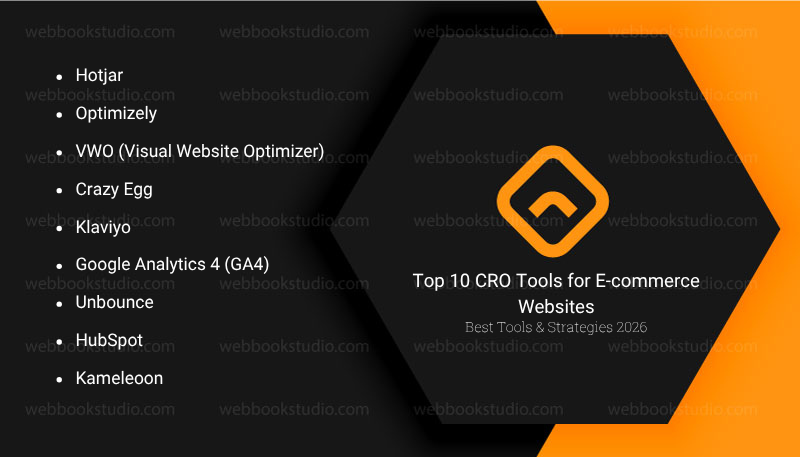
Choosing the right tools is critical for effective conversion optimization for e-commerce website success. Below are the best 10 CRO tools and strategies 2026 used by e-commerce businesses worldwide, from startups to enterprise brands. Each tool is selected based on usability, features, scalability, and real-world performance.
1. Hotjar: See Exactly How Real People Use Your Store
Hotjar delivers heatmaps, session recordings, and on-site surveys. Best for user behavior insights & heatmaps, it helps you visualize how users interact with your website through heatmaps, session recordings, and feedback polls.
Key Features: Hotjar Tool Conversion Optimization for E-commerce Website.
- Heatmaps (click, scroll, move)
- Session recordings
- On-site surveys
- Funnel analysis
Use Case: Identify why users abandon product pages or checkout. Numbers tell you “what” happened; recordings show “why.” You watch visitors struggle with your mega menu or hesitate on a “buy now” button.
Example: A worldwide beauty brand discovered most users never scrolled past the first product image on mobile. They added a sticky “quick add” button and lifted conversions 18%. Ideal for e-commerce because it works seamlessly with Shopify, WooCommerce, and BigCommerce. Free tier available; paid plans scale with traffic.
2. Optimizely: Best for advanced A/B testing & experimentation.
Optimizely is a powerful platform for running experiments across websites and apps to improve conversion rates. One-size-fits-all pages lose customers. Dynamic content that changes per visitor feels magical and converts higher.
Key Features Optimizely Tool:
- A/B and multivariate testing
- Personalization engine
- Real-time analytics
Use Case: Test different product page layouts to find the highest-converting version. Let’s you run full-stack experiments and deliver personalized experiences based on behavior, location, or past purchases.
Example: A US home-goods brand showed different hero images and product recommendations to first-time versus returning visitors. Revenue per visitor jumped 34%. Enterprise pricing, but the lift justifies it for stores doing $1M+ in monthly revenue.
3. VWO (Visual Website Optimizer): The All-in-One CRO Powerhouse.
VWO (Visual Website Optimizer) is a premier all-in-one CRO platform designed for data-driven experimentation, testing, and behavioral insights. It is best suited for marketing, product, and engineering teams seeking to consolidate heatmaps, A/B testing, and personalization tools into a single unified platform.
Key Features and Use Cases: VWO Best For: All-in-one CRO platform.
VWO Combines Testing, Insights, and Personalization Into One Platform.
- Testing VWO: Conducts A/B, multivariate, and split URL tests with a no-code visual editor.
- Insights VWO: Provides qualitative data via heatmaps, session recordings, and on-page surveys.
- VWO Personalize: Delivers tailored experiences to specific customer segments.
- Feature VWO Experimentation: Enables server-side testing for engineering teams to deploy features safely.
- VWO Copilot: Uses AI to generate insights, summarize survey data, and suggest test ideas.
Use Case: Optimize landing pages and checkout flows. All capabilities, from research to testing, are in one place, allowing data to flow seamlessly between tools. It’s frequently chosen as a robust alternative to Google Optimize, offering more sophisticated behavioral and testing features.
4. Crazy Egg Best for: Click Tracking & Visual Reports
Crazy Egg specializes in visual reports, click heatmaps, scrollmaps, and confetti reports that segment by traffic source. It provides easy-to-understand visual reports showing how users interact with your site.
Key Features: Visual Data is Faster to Act on than Spreadsheets.
- Heatmaps and scroll maps
- Confetti reports and click segmentation
- A/B testing
For example, a gadget store learned that “add to cart” buttons below the fold on mobile got almost zero clicks. They moved them higher and saw immediate sales growth. Great for small teams because the reports are dead simple.
Use Case: Discover which parts of your page attract the most attention.
5. Dynamic Yield: AI-driven personalization
Dynamic Yield allows ecommerce brands to deliver personalized experiences across web, mobile, and email. It allows businesses to personalize experiences at a granular level, tailoring content to individual preferences. Element leverages AI to analyze user behavior and deliver highly targeted recommendations. AI-enhanced automation is another key aspect of Dynamic Yield’s platform.
Key Features: AI and automation in Dynamic Yield
- Product recommendations
- Behavioral targeting
- Omnichannel personalization
Use Case: Show personalized product suggestions to increase AOV.
6. Klaviyo Best for: Email-based CRO & retention
Klaviyo is essential for converting and retaining customers through email and SMS automation. It is the autonomous B2C CRM and AI marketing platform that unifies customer data and automates email, SMS, RCS, WhatsApp, and mobile push to drive personalized, revenue-generating campaigns.
Built as both a system of record and system of action, Klaviyo combines a customer data platform, real-time signals, and AI agents to power automated insights and one-click execution.
Key Features: Klaviyo offers native integrations with e-commerce platforms
- Automated email flows
- Segmentation
- Abandoned cart recovery
Use Case: Recover lost sales through targeted email campaigns.
7. Google Analytics 4 (GA4): Data tracking & Performance Analysis
Google Analytics is a must-have for understanding traffic, user behavior, and conversion paths. GA4 is the starting point for almost every serious store. It tracks events, funnels, and user journeys across devices without the old “pageview” limitations. You cannot improve what you do not measure. GA4 shows exactly where drop-offs happen on product pages, add-to-cart, or checkout steps.
GA4 Key Features for Traffic Analysis, Conversion Tracking, Funnel Visualization:
- Event-Based Tracking: Unlike old systems, GA4 tracks every interaction (clicks, scrolls, video views) as an event, providing a clearer view of user engagement.
- Enhanced Measurement: Automatically tracks key actions like outbound clicks, file downloads, and site searches without extra coding.
- Predictive Metrics: Uses machine learning to calculate purchase, churn, and revenue probability, identifying high-value customers and potential lost sales.
- Data-Driven Attribution: Instead of last-click, GA4 uses ML to weigh multiple touchpoints, offering a more accurate picture of marketing ROI.
- Free Funnel Exploration: Build custom funnels (e.g., product view, add to cart, checkout purchase) to pinpoint where users drop off.
Your Free Foundation for Conversion Optimization for E-commerce Website.
Essential GA4 Reports for E-commerce:
- Monetization Overview/Ecommerce Purchases: Tracks revenue, transactions, and product-level performance.
- Purchase Journey/Checkout Funnel: Visualizes the path to purchase to identify bottlenecks in the checkout process.
- Traffic Acquisition: Shows which channels (social, search, ads) generate the highest revenue.
- Landing Page Report: Identifies which pages attract the most engaged traffic and convert best.
Important Tip: Set data retention to 14 months (instead of the 2-month default) to allow for year-over-year comparisons.
Example: A US electronics retailer saw 40% of mobile users abandon at the shipping step. GA4 revealed that the form loaded slowly on 3G networks. They simplified it and recovered 15% of lost sales. Pricing Free (premium enterprise version available). Start here before layering anything else.
Use Case Google Analytics 4 (GA4): Identify where users drop off in the buying journey.
8. Unbounce Build and Test High-Converting Landing Pages in Minutes
Unbounce helps marketers build and test landing pages without coding. It is the go-to landing page builder with built-in A/B testing and AI copy suggestions. Paid ads send traffic to generic homepages that confuse buyers. Dedicated, focused pages convert far better.
Key Features: Best for High-converting Landing Pages
- Drag-and-drop builder
- A/B testing
- AI-powered optimization
Use Case: Create optimized landing pages for paid traffic campaigns.
Example: A fitness supplement brand created campaign-specific pages for each ad group. Conversions from ads doubled. The Smart Traffic feature automatically routes visitors to the best-performing variant.
9. HubSpot Best for: CRM-driven CRO insights
HubSpot connects customer data with marketing performance to improve conversions. It is best for businesses seeking to drive Conversion Rate Optimization (CRO) through unified CRM data, enabling personalized marketing, faster sales cycles, and improved customer retention. It excels by linking website, sales, and support interactions into a single timeline, allowing teams to identify and replicate winning tactics.
Key Features & Strengths for CRM-Driven CRO:
- Unified Customer View: Eliminates data silos by combining CRM data with marketing, sales, and service insights.
- Actionable Insights: Uses built-in AI (Breeze) and reporting dashboards to analyze conversion rates, deal velocity, and customer engagement to inform strategy.
- Proactive Personalization: Leverages comprehensive data to create targeted campaigns and tailored customer experiences that increase conversion rates.
- High Adoption & Ease of Use: Designed to be user-friendly, leading to higher team adoption rates compared to more complex, disparate systems.
- Tangible ROI: 76% of users experience a return on investment, with 64% achieving it in four weeks or less.
HubSpot is particularly well-suited for small and medium-sized businesses, as well as enterprises that need a scalable, all-in-one platform to streamline operations and enhance lead conversion.
Use Case: Track user journeys and optimize based on lifecycle data. CRM integration, Marketing automation, Analytics dashboard.
10. Kameleoon: AI-Powered Personalization Without the Headache
Kameleoon uses AI to test and personalize in real time. It’s an optimization solution with experiment, AI-powered personalization, and feature management capabilities in a single unified platform. Machine learning spots patterns humans miss and delivers the right offer at the right moment.
Kameleoon is a unified, AI-powered platform for A/B testing, feature management, and personalization, designed for marketers and developers to run client-side and server-side experiments.
Key features of Kameleoon Tool:
- Include AI-driven prompt-based experimentation (PBX),
- Advanced traffic allocation,
- A “flicker-free” engine for SPAs,
- Strong analytics and 100+ native integrations
Example: A European fashion retailer showed urgency banners (“Only 3 left in your size”) to high-intent visitors. Cart completions rose 21%. Strong GDPR compliance makes it safe for worldwide stores.
Use cases: Kameleoon sends custom events to Braze to identify users participating in experimentation and personalization campaigns, enabling more precise targeting and personalized messaging.
How to Choose the Right CRO Tool for Your E-commerce Business?
Selecting the right tool is a critical step in your best conversion-optimization strategy for your e-commerce website. With so many options available, the best choice depends on your business goals, technical capabilities, and growth stage, not just features. Instead of chasing the “most popular” tool, focus on what will solve your specific conversion challenges.
Here is a 10 Top Conversion Optimization for E-commerce Website CRO Tools Comparison
| Tool | Core Feature | Best For | Ease of Use | Pricing Level |
| Hotjar | Heatmaps & session recordings | Beginners & SMBs | Easy | Free + Paid |
| Optimizely | A/B & multivariate testing | Enterprise | Advanced | Premium |
| VWO | All-in-one CRO suite | Growing businesses | Moderate | Paid |
| Crazy Egg | Click & scroll tracking | Small businesses | Easy | Paid |
| Dynamic Yield | AI personalization | Enterprise ecommerce | Advanced | Premium |
| Klaviyo | Email & SMS automation | E-commerce brands | Easy | Free + Paid |
| Kameleoon | AI-powered personalization | SMBs | Easy | Paid |
| Unbounce | Landing page optimization | Marketers & agencies | Easy | Paid |
| HubSpot | CRM & analytics | Scaling businesses | Moderate | Free + Paid |
| Google Analytics | Traffic & behavior tracking | All business sizes | Moderate | Free |
There is no “one-size-fits-all” solution for conversion optimization for e-commerce websites. The best tool is the one that aligns with your goals, resources, and growth stage. Start simple, test consistently, and expand your CRO stack as your business evolves.
Conclusion: Turn Traffic Into Revenue with Smart CRO
Conversion optimization for e-commerce websites is no longer a luxury, and it’s a necessity for any business that wants to grow sustainably in today’s competitive digital marketplace.
While driving traffic through SEO, paid ads, or social media is important, the real impact comes from how effectively you convert that traffic into customers.
Explored how tools like Hotjar, VWO, and Google Analytics help you understand user behavior, test improvements, and make data-driven decisions. Combined with proven CRO strategies such as optimizing product pages, simplifying checkout, and personalizing user experiences, you can unlock significant growth without increasing your marketing spend.
From a Google EEAT perspective, successful ecommerce brands rely on:
- Experience: Continuously testing and learning from real user interactions
- Expertise: Using the right tools and proven methodologies
- Authority: Implementing industry-standard CRO platforms
- Trust: Creating seamless, secure, and user-friendly shopping experiences
The key takeaway CRO is an ongoing process, not a one-time fix. Small, consistent improvements backed by data can lead to substantial increases in conversion rates, revenue, and customer loyalty.
The best action step to start is simply to analyze your current performance, identify one major bottleneck, and use a CRO tool to test and improve.
Then scale your efforts as you grow. In a world where every click matters, businesses that prioritize conversion optimization for e-commerce websites will always have a competitive edge, turning visitors into buyers and opportunities into long-term success.
Helpful article: How to Integrate Landing Pages with Your CRM for Better Lead Management?
FAQ: Conversion Optimization for E-commerce Website
1. What is Conversion Optimization for E-commerce Website?
Conversion optimization for e-commerce website (CRO) is the process of improving your online store to increase the percentage of visitors who complete a desired action, such as making a purchase, signing up, or adding items to the cart. It focuses on enhancing user experience, reducing friction, and using data-driven strategies to boost sales.
2. What is a good e-commerce conversion rate?
A good e-commerce conversion rate typically ranges between 2% to 4%, depending on the industry, product type, and target audience. However, high-performing ecommerce stores can achieve even higher rates through effective CRO strategies and tools.
3. Which is the best CRO tool for small business ecommerce?
There is no single “best” tool; it depends on your needs. For example, Hotjar is great for user behavior insights, VWO is ideal for A/B testing, and Google Analytics is essential for data tracking. The best approach is to combine multiple tools for a complete CRO strategy.
4. How can I improve my Conversion Optimization for E-commerce Website rate quickly?
You can improve conversions quickly by simplifying your checkout process and adding trust signals (reviews, badges), product pages for better images, and descriptions. Running A/B tests using tools like Optimizely, even small changes can lead to noticeable improvements.
5. Are free CRO tools effective?
Yes, free tools like Google Analytics can be very effective for tracking user behavior and identifying issues. However, combining free tools with paid solutions like Crazy Egg or Hotjar can deliver better results.
6. How long does it take to see results from CRO?
CRO results can vary, but most businesses start seeing measurable improvements within a few weeks to a few months, depending on:
- Traffic volume
- Testing frequency
- Changes implemented
CRO is a continuous process, not a one-time effort.
7. Why is cart abandonment so high in e-commerce?
Cart abandonment often happens due to:
- Unexpected costs (shipping, taxes)
- Complicated checkout process
- Lack of trust or security concerns
- Slow website performance
CRO tools help identify and fix these issues to recover lost sales.