

Best Free Landing Page Builder Benefits for Small Businesses & Agencies 2026.
A free landing page is one of the most effective solutions for businesses that want to improve lead generation, increase conversion rates, and launch professional digital marketing campaigns without investing in expensive custom web development.
Modern landing page builders now allow startups, small businesses, agencies, ecommerce brands, and service providers to create responsive landing pages using drag-and-drop editors, mobile-friendly templates, AI-powered design tools, and conversion-focused layouts optimized for user experience and SEO.
Platforms like Wix, Canva, Google Sites, Carrd, and Unbounce help businesses create landing pages for email marketing, product launches, affiliate marketing, SaaS promotions, webinar registrations, ecommerce campaigns, and local business advertising without requiring advanced coding knowledge in HTML, CSS, React, or frameworks like Bootstrap and Tailwind CSS.
With features such as squeeze page templates, CTA optimization, A/B testing, free hosting, custom domains, analytics dashboards, and integrations with Mailchimp, HubSpot, and Google Analytics, businesses can build high-converting landing pages designed to improve customer engagement, support sales funnels, and generate more qualified leads.
AI tools like ChatGPT and Claude, and design platforms such as Figma, are also transforming how businesses create free landing page templates, responsive UI layouts, and conversion-focused website experiences for modern online marketing strategies.
What Is a Free Landing Page Builder?
A free landing page builder is a no-code or low-code platform that helps businesses create standalone web pages designed specifically for lead generation, customer engagement, and conversion optimization.
Unlike a traditional website homepage that contains multiple navigation links and broad information, a landing page focuses on a single goal, such as collecting email signups, promoting a service, generating sales leads, booking consultations, launching a product, or encouraging visitors to take action through a strong call-to-action (CTA).
Modern landing page builders simplify the web design process by offering drag-and-drop editors, responsive templates, smartphone optimization, custom forms, analytics integrations, and AI-powered design assistance.
Businesses can quickly create squeeze pages without advanced programming skills in HTML, CSS, JavaScript, React, or frameworks like Bootstrap and Tailwind CSS.
Many platforms also support custom domains, SEO settings, A/B testing, responsive UI design, and landing page analytics, making them powerful tools for digital marketing, email campaigns, ecommerce promotions, webinar registrations, and online lead generation.
6 Top Benefits of Using a Free Landing Page Builder
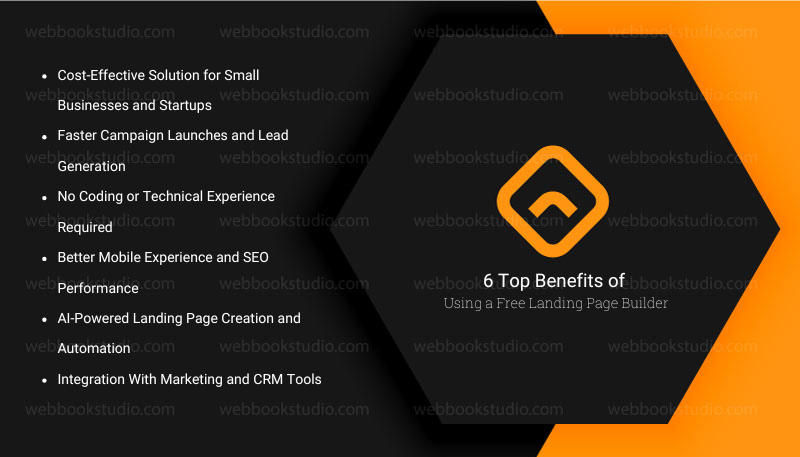
A free landing page builder offers businesses a faster, more affordable, and conversion-focused way to grow their online presence without the complexity of traditional website development.
If the goal is lead generation, email marketing, product promotion, affiliate marketing, or local business advertising, modern landing page platforms help businesses create professional pages optimized for user experience, mobile responsiveness, and conversion rate optimization (CRO).
1. Cost-Effective Solution for Small Businesses and Startups
One of the biggest benefits of using a free landing page builder is reducing the cost of web design and website development. Many startups and small businesses cannot afford custom-coded websites, UI/UX designers, or advanced development teams.
Platforms like Wix, Carrd, and Google Sites allow businesses to launch professional landing pages using free templates, drag-and-drop editors, and built-in hosting, without requiring knowledge of HTML, CSS, or React.
2. Faster Campaign Launches and Lead Generation
Businesses often need to launch marketing campaigns quickly for product launches, webinar registrations, local services, ecommerce promotions, or seasonal offers.
Free landing page builders simplify this process with responsive landing page templates, pre-designed layouts, and customizable CTA sections that improve customer engagement and lead capture.
Tools like Unbounce and Canva help businesses create conversion-focused destination pages optimized for email signups, consultation bookings, and sales funnels in significantly less time compared to traditional website development.
3. No Coding or Technical Experience Required
Modern no-code website builders make squeeze page creation accessible for beginners, entrepreneurs, agencies, freelancers, and local businesses.
Instead of manually designing pages with Bootstrap frameworks, Tailwind CSS layouts, JavaScript interactions, or custom HTML templates, users can visually customize pages using drag-and-drop builders and AI-powered design systems.
This allows businesses to focus more on marketing strategy, branding, and customer acquisition rather than technical development challenges.
4. Better Mobile Experience and SEO Performance
Responsive design and mobile optimization are essential for modern digital marketing campaigns because most users now browse websites on smartphones and tablets.
Free landing page builders automatically optimize layouts, typography, forms, images, and CTA buttons for different screen sizes, improving user experience, page speed, and SEO (Search Engine Optimization) performance.
Many platforms also provide SEO settings, metadata customization, image optimization, and analytics integrations that help businesses improve visibility in search engines and track conversion performance through tools like Google Analytics.
5. AI-Powered Landing Page Creation and Automation
AI technology is transforming how businesses create websites and landing pages. AI-powered tools like ChatGPT or Claude AI and modern landing page generators can help businesses create headlines, marketing copy, CTA sections, responsive layouts, and conversion-focused content faster than traditional design workflows.
Platforms now combine AI website generation, automation, and user behavior insights to help businesses improve lead generation, customer engagement, and digital marketing performance with less manual effort.
6. Integration With Marketing and CRM Tools
Free landing page builders also integrate with email marketing platforms, CRM software, automation systems, and analytics dashboards to improve marketing efficiency.
Businesses can connect landing pages with Mailchimp, HubSpot, and other lead generation tools to automate customer follow-ups, manage contact forms, track conversions, and improve sales funnel performance.
This creates a complete marketing ecosystem that supports business growth, customer acquisition, and long-term online visibility.
7 Best Free Landing Page Builders for Businesses and Marketers
Choosing the right free landing page builder depends on your business goals, marketing strategy, customization needs, and conversion objectives. Some platforms focus on simple drag-and-drop website creation, while others specialize in lead generation, AI-powered design, e-commerce marketing, or advanced conversion optimization.
The best welcome page builders combine responsive design, SEO-friendly layouts, mobile optimization, analytics tracking, and user-friendly editing tools to help businesses create high-converting landing pages without advanced coding experience.
1. Wix: Most Popular Free Landing Page Builders
Wix is one of the most popular free landing page builders for small businesses, startups, agencies, and service providers. It offers AI-powered website creation, drag-and-drop editing, responsive landing page templates, free hosting, and SEO tools that help businesses launch professional marketing pages quickly.
Wix is ideal for local businesses, portfolio websites, ecommerce promotions, and lead generation campaigns because it combines design flexibility with beginner-friendly customization features.
2. Canva: Best Free Landing Page Design Platform
Canva is widely used for creating visually engaging landing page designs, marketing graphics, social media campaigns, and promotional pages. Its template-based editor allows businesses to create mobile-friendly landing pages with strong branding, CTA sections, and modern UI layouts without needing technical design skills. Canva is especially useful for startups, creators, agencies, and marketers focused on visual storytelling and fast campaign launches.
3. Google Sites: Simple and Basic Free Landing Page Solution
Google Sites provides a simple and completely free solution for businesses that need basic landing page design price, internal project pages, educational websites, or lightweight promotional campaigns. It integrates well with Google Workspace tools and offers an easy setup process for beginners who want to create a free landing page without having to manage complex hosting or development environments.
4. Carrd: Minimalist one-page Free Squeeze Page design
Carrd specializes in minimalist one-page websites and welcome pages designed for creators, freelancers, startups, and affiliate marketers. Its lightweight design system, mobile responsiveness, and fast-loading templates make it a strong option for lead generation pages, personal branding, SaaS promotions, and simple product launches.
5. Unbounce: Advanced and Heavy Features for Free Landing Pages
Unbounce focuses heavily on conversion optimization and advanced digital marketing features. It offers A/B testing, AI copy generation, smart traffic optimization, analytics integrations, and conversion-focused landing page templates that help businesses improve campaign performance and increase lead generation. Unbounce is commonly used by marketing agencies, SaaS companies, ecommerce brands, and businesses running paid advertising campaigns through Google Ads.
6. MailerLite: Free Landing Page For Email Marketing Campaign
MailerLite combines splash page creation with email marketing automation, making it useful for businesses focused on newsletter growth, webinar registration, customer engagement, and lead nurturing. It includes landing page templates, signup forms, automation workflows, and analytics tools that support conversion-focused email marketing strategies.
7. Choosing the Right Squeeze Page Builder
The best free landing page builder depends on factors such as:
- Business goals
- Conversion strategy
- SEO requirements
- AI features
- Mobile responsiveness
- Marketing integrations
- Custom domain support
- E-commerce functionality
- Landing page templates
- (User Experience) UX design
Businesses looking for scalable lead generation and stronger digital marketing performance should prioritize platforms that offer responsive design, conversion tracking, analytics dashboards, AI automation, and integrations with tools like HubSpot, Mailchimp, and Google Analytics to support long-term customer acquisition and online growth.
Pros and Cons of Free Landing Page Builders
Selecting the right free splash page builder is not just about choosing a tool, but choosing a system that directly supports your lead generation, conversion optimization, and overall digital marketing strategy.
| Pros: | Cons: |
| Cost-effective testing. | Branding or subdomains on free tiers (affects professionalism). |
| Quick deployment. | Feature limits (advanced A/B testing, custom code, removals of limits). |
| User-friendly interfaces. | Potential performance caps or traffic limits. |
| Mobile-responsive templates. | Less control over SEO or loading speed compared to self-hosted options. |
| Basic analytics and forms. | Data ownership or export concerns in some tools. |
| Scalable to paid plans. | AI Technology performs best in design Similarity competitors |
Solutions: Start free to validate, upgrade strategically when metrics justify it. Use custom domains on paid plans for credibility. Combine with free analytics like Google Analytics where possible. For advanced needs, export designs or migrate to self-hosted builders like WordPress with Elementor.
7 Most Common Mistakes to Avoid When Using a Free Landing Page Builder
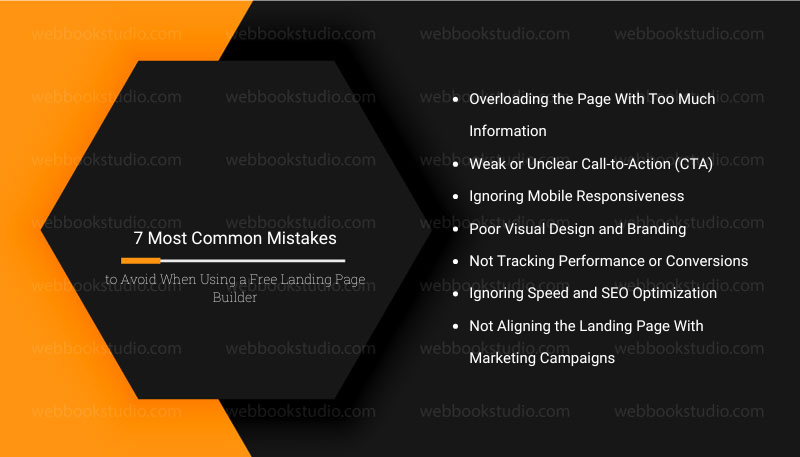
Even though a free landing page builder makes it easier to create professional marketing pages, many businesses still fail to get results because they ignore conversion-focused design principles, user experience, and proper lead generation strategy. Understanding these mistakes is important for startups, small businesses, agencies, e-commerce brands, and service providers who want to turn website visitors into real customers.
1. Overloading the Page With Too Much Information
One of the most common mistakes is adding too much content, too many links, or unnecessary sections that distract users from the main goal. A Destination page should focus on a single conversion objective, such as signups, bookings, or purchases. When pages become cluttered, users lose focus and bounce rates increase, reducing overall conversion performance.
2. Weak or Unclear Call-to-Action (CTA)
A Click-Through page must guide users toward a specific action, but many businesses fail by using unclear or generic CTA buttons. Instead of “Submit” or “Click Here,” effective landing pages use action-driven messaging like “Get Your Free Quote,” “Start Free Trial,” or “Book a Consultation.” Strong CTA optimization is a key part of conversion rate optimization (CRO) and directly impacts lead generation results.
3. Ignoring Mobile Responsiveness
Since most users browse on mobile devices, failing to optimize for a mobile experience can significantly reduce engagement and conversions. Many free landing page builders like Wix, Carrd, and Google Sites offer responsive design features, but businesses still need to ensure layouts, images, forms, and buttons are properly optimized for all screen sizes.
4. Poor Visual Design and Branding
A landing page with inconsistent colors, low-quality images, or an unstructured layout can reduce trust and credibility. Businesses should use clean UI/UX design principles, modern templates, and consistent branding elements. Platforms like Canva and Figma help improve visual design quality and maintain professional branding across landing pages.
5. Not Tracking Performance or Conversions
Many businesses fail to measure how their landing pages perform, which makes it impossible to improve results. Without analytics, it is difficult to understand user behavior, traffic sources, and conversion rates. Integrating tools like Google Analytics or CRM systems like HubSpot is essential for tracking performance, optimizing campaigns, and improving ROI.
6. Ignoring Speed and SEO Optimization
Slow-loading pages, unoptimized images, and missing SEO settings can negatively affect visibility in search engines and user experience. A good welcome page should load quickly, include proper meta tags, use structured content, and follow SEO best practices to improve ranking potential and organic traffic.
7. Not Aligning the Landing Page With Marketing Campaigns
A Target page must match the message of your ads, email campaigns, or social media promotions. When there is a mismatch between ad copy and landing page content, users lose trust and leave the page. If you are running Google Ads campaigns, email marketing campaigns, or social media promotions, consistency is essential for improving conversion rates and lead generation success.
How to Choose the Best Free Landing Page Builder for Your Business?
Selecting the right free landing page builder is not just about choosing a tool, but choosing a system that directly supports your lead generation, conversion optimization, and overall digital marketing strategy.
For startups, small businesses, agencies, ecommerce brands, and service-based companies, the right platform can significantly impact how fast you launch campaigns and how effectively you turn visitors into customers.
1. Define Your Business Goal First
Before choosing any platform, clearly identify what your squeeze page is meant to achieve. Different goals require different features:
- Lead generation with email signups, consultations, and quote requests
- Sales conversions for product or service purchases
- Marketing campaigns with Google Ads, social media ads
- Brand awareness by portfolio, agency showcase
- Event registrations, webinars, and workshops
A clear goal ensures your landing page structure, CTA, and design stay focused on conversions instead of distractions.
2. Check Ease of Use and No-Code Flexibility
A good free landing page builder should allow users to build pages without technical skills in HTML, CSS, or JavaScript. Drag-and-drop editors, AI assistance, and pre-built templates help speed up development and reduce dependency on developers.
Platforms like Wix, Carrd, and Google Sites are popular because they simplify the entire website creation process for beginners and non-technical users.
3. Evaluate Design Quality and Templates
Design plays a major role in user experience and conversion rate optimization (CRO). A high-quality landing page should include:
- Modern UI/UX layout
- Responsive mobile design
- High-converting landing page templates
- Clear visual hierarchy
- Strong CTA placement
Tools like Canva and Figma can also help businesses design better landing page visuals and prototypes before development.
4. Look for AI and Automation Features
Modern landing page builders are increasingly using AI to improve productivity and marketing performance. AI tools can help with:
- Copywriting and headlines
- Landing page layout suggestions
- CTA optimization
- SEO improvements
- Conversion-focused content creation
AI-powered platforms and tools help businesses quickly generate landing page content, improving speed and consistency in marketing campaigns.
5. Check Marketing and CRM Integrations
A landing page is not just a design asset, and it is a lead generation system. That’s why integration with marketing tools is essential. The best platforms connect easily with:
- Email marketing tools
- CRM systems
- Analytics platforms
- Automation workflows
Integrations with Mailchimp, HubSpot, and Google Analytics allow businesses to track user behavior, manage leads, and improve conversion performance effectively.
6. Consider Scalability and Long-Term Growth
While free landing page builders are great for starting, businesses should also consider future scalability. As traffic grows and campaigns expand, you may need features like:
- Custom domain support
- A/B testing
- Advanced analytics
- Faster hosting performance
- SEO customization
Choosing a platform that supports long-term growth ensures your welcome pages remain effective as your business expands.
7. Free Landing Page Advanced Tips for Better Results
Focus on headlines that speak directly to pain points. Use high-quality images or videos. Add trust signals, guarantees, and reviews. Test variations even on free plans by duplicating pages.
Prioritize speed, compress images, and choose lightweight designs. Ensure accessibility and clear privacy policies for compliance.
For 2026, trends embrace bold typography, personalized elements via basic dynamic content if available, conversational forms, and trust-first designs with transparent pricing or verified badges.
Common User Problems and Practical Solutions
| Problem | Solution |
| Branding makes it look unprofessional. | Use for testing and internal campaigns; upgrade or embed on your main site when ready. |
| Limited analytics. | Integrate free Google Analytics or Tag Manager. |
| Scaling traffic or features. | Monitor performance; upgrade only when ROI is clear. Many tools offer smooth paths. |
| SEO concerns. | Optimize meta titles, descriptions, headings, and fast loading. Use builders with good SEO settings. |
A free landing page is no longer just a simple web page; it has become a powerful digital marketing tool for startups, small businesses, agencies, and service providers that want to generate leads, run advertising campaigns, and grow online without heavy investment in full-scale website development.
Conclusion: Why Free Landing Pages Are a Smart Choice for Business Growth
Empowering your next move, a free landing page builder represents more than a tool that levels the playing field. In 2026, success belongs to those who test ideas quickly, learn from real data, and connect authentically with audiences.
Start small, stay focused, measure results, and scale what works. If you’re building a personal brand, launching a product worldwide, or supporting a local business, these platforms give you the foundation without the financial weight.
The market’s strong growth signals continued innovation, better AI, and more value in free tiers. Your next big opportunity might begin with a simple page built in an afternoon.
Free landing page creation, helping beginners, startups, and service-based businesses make informed decisions before choosing a landing page builder. Take that step, create, publish, and see what happens. The tools are ready. The question is if you are.
Helpful article: Top 10 Landing Page Examples to Inspire Your Next Campaign
FAQs Free Landing Page Guide: Benefits, Tools, and High-Converting Strategies.
1. What is a free landing page?
A free landing page is a standalone web page created using a free squeeze page builder that focuses on a single goal, such as lead generation, sales, bookings, or signups. It is designed to convert visitors through clear messaging, strong call-to-action (CTA) buttons, and a conversion-focused layout without requiring advanced coding or paid web development.
2. Can I create a landing page without a website?
Yes, you can create a landing page without having a full website. Platforms like Google Sites, Carrd, and Wix allow users to publish standalone landing pages that work independently and can be used for marketing campaigns, ads, or lead generation funnels.
3. Does Google offer a free landing page builder?
Yes, Google provides a simple solution through Google Sites. It allows users to create basic splash pages for free, making it suitable for beginners, internal business pages, and simple marketing campaigns, though it offers fewer advanced marketing features than dedicated landing page platforms.
4. Can AI build me a landing page?
Yes, AI tools can now help generate landing pages automatically, including layout, copywriting, and design suggestions. Many AI platforms assist in creating headlines, CTAs, and marketing content, while many modern builders also include AI landing page generation features to speed up website creation and improve conversion optimization.
5. Can I use a landing page for lead generation?
Yes, landing pages are one of the most effective tools for lead generation. They are designed to capture user information through forms, email signups, or CTA actions. When integrated with tools like Mailchimp or HubSpot, they help businesses build email lists, nurture leads, and improve conversion rates.
6. Is a free landing page good for business growth?
Yes, a free landing page is often the first step for startups and small businesses to validate ideas, test marketing campaigns, and generate leads without high upfront costs. When combined with SEO, paid ads, and email marketing strategies, it can become a powerful tool for scaling digital marketing performance.
7. What makes a high-converting landing page?
A high-converting landing page includes a clear value proposition, strong CTA buttons, and a mobile-responsive design. Fast loading speed, trust signals (reviews, logos, testimonials). Simple layout focused on one goal. These elements improve user experience, reduce bounce rates, and increase conversions.