

Can AI Make MVP Development for Startups Faster and Cheaper?
MVP development for startups is becoming faster, smarter, and more affordable because of Artificial Intelligence (AI). Many startup founders have great ideas but struggle with limited budgets, lengthy development cycles, and the risk of building a product customers may not want.
AI helps solve these problems by speeding up research, planning, rapid prototyping, UI/UX design, coding, testing, and product validation.
Instead of spending months creating a full web application, mobile app, or SaaS product, startups can build a Minimum Viable Product (MVP), collect user feedback, and improve product-market fit before making a bigger investment.
When AI is combined with Lean Startup thinking, Agile development, experienced developers, cloud infrastructure, API integration, and continuous iteration, startups can reduce development costs, shorten time to market, and build scalable products with greater confidence.
This helpful guide explains how AI is transforming MVP development for startups, where it adds the most value, and how founders can use it to launch successful products faster.
What Is MVP Development for Startups?
MVP development for startups is the process of building the first working version of a product with only the essential features. The goal is to launch quickly, solve one core problem, and learn from real users before investing more time and money.
To create a complete product, startups build a Minimum Viable Product (MVP) to test an idea in the market. This helps founders validate demand, collect user feedback, and find product-market fit with lower risk.
A startup MVP can be a web application, mobile app, SaaS platform, or marketplace. It should include only the features needed for users to complete the main task. Extra features can be added after analyzing customer feedback and product performance.
Today, AI is making MVP development faster and more efficient. AI tools help with market research, feature prioritization, rapid prototyping, UI/UX design, coding, testing, and documentation. This reduces manual work and shortens the development timeline while allowing teams to focus on building a product that meets real user needs.
The purpose of MVP development is not to build a perfect product. It is to launch early, learn from users, improve through continuous iteration, and grow with confidence.
Why Is Traditional MVP Development Becoming Slower?
Traditional MVP development often takes longer because every stage depends on manual work. Teams spend weeks planning, conducting market research, designing, coding, testing, and fixing issues before the product is ready to launch.
Many startups also try to add too many features in the first version. This increases development time, raises costs, and delays user feedback. By testing one core idea, the team builds features that users may never need.
Small startups often face limited budgets and fewer developers. As a result, tasks move slowly, and deadlines become difficult to meet. Late product launches can also give competitors a chance to reach the market first.
Manual testing, repeated code changes, and slow communication between teams add more delays. Without fast insights from analytics and customer feedback, improving the product also takes longer.
These challenges are why many startups are turning to AI. It helps automate repetitive tasks, speeds up development, and allows teams to launch an MVP faster without sacrificing quality.
What Role Does AI Play in MVP Development?
The service market around MVP development continues to grow. One industry analysis placed the global MVP development service market at approximately $2.15 billion in 2025, with projections reaching $5.22 billion by 2032 at a compound annual growth rate of about 13.5%.
North America accounts for the largest share, followed by Europe and Asia-Pacific. Startups and small-to-medium enterprises represent the majority of demand, roughly 60 percent in recent breakdowns.
Within that market, AI-native or AI-assisted builds are expanding rapidly because they deliver faster feedback loops and lower capital requirements. Investors increasingly expect founders to show working products rather than just decks. When a functional prototype can be produced at lower cost, more experiments become possible, and the quality of early traction signals improves.
AI helps startups build an MVP faster by supporting every stage of the development process. It automates repetitive tasks, improves decision-making, and reduces the time needed to launch a product.
During planning, AI analyzes market research, customer trends, and user behavior to help validate ideas. It also helps identify the most valuable features, making feature prioritization easier.
In the design stage, AI can generate wireframes, UI layouts, and design suggestions. During development, AI coding assistants help developers write code, fix errors, and create documentation more quickly.
AI also improves quality assurance by automating testing, finding bugs, and checking application performance before launch. After deployment, AI analyzes user feedback and product analytics, helping startups improve the MVP through continuous iteration.
Replacing developers, AI works as a productivity tool. It allows startup teams to spend less time on repetitive work and more time building a product that solves real customer problems.
Benefits of AI-Powered MVP Development for Startups
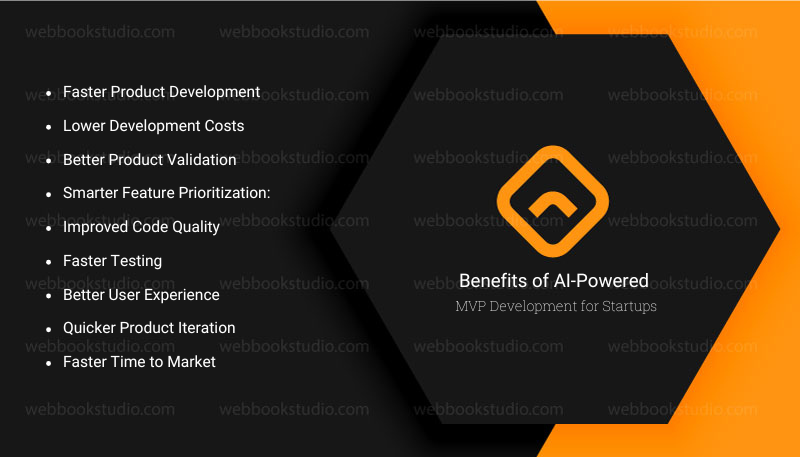
AI gives startups a faster and smarter way to build an MVP. It reduces manual work, speeds up development, and helps teams make better decisions from the beginning.
- Faster Product Development: AI automates research, coding, testing, and documentation. This helps startups launch an MVP in less time.
- Lower Development Costs: By reducing repetitive tasks, AI lowers development effort and helps startups use their budget more efficiently.
- Better Product Validation: AI analyzes market data, customer research, and user feedback to help founders validate ideas before adding more features.
- Smarter Feature Prioritization: AI identifies the features that provide the most value, keeping the MVP simple and focused on user needs.
- Improved Code Quality: AI coding assistants help write cleaner code, detect errors early, and reduce debugging time.
- Faster Testing: AI-powered testing tools find bugs, check performance, and improve software quality before release.
- Better User Experience: AI reviews user behavior and analytics to help teams improve the UI/UX based on real customer interactions.
- Quicker Product Iteration: After launch, AI helps analyze feedback and product data, making it easier to update and improve the MVP through continuous iteration.
- Faster Time to Market: By speeding up every stage of development, AI helps startups launch earlier, collect real-world feedback sooner, and stay ahead of competitors.
How AI Changes Every Stage of MVP Development
AI supports the entire MVP development process, from the first idea to product improvements after launch.
- Idea Validation: AI analyzes market trends, customer needs, and competitor data to help founders evaluate whether an idea has real demand.
- Market Research: AI collects and organizes large amounts of data, making it easier to identify target audiences, customer pain points, and business opportunities.
- Feature Prioritization: AI helps select the most important features for the first release, keeping the MVP simple and focused.
- Wireframing and UI/UX Design: AI tools generate wireframes, layouts, and design suggestions, allowing designers to create user-friendly interfaces more quickly.
- Coding and Development: AI coding assistants speed up software development by generating code, suggesting improvements, and helping fix errors.
- Testing and Quality Assurance: AI automates testing, detects bugs, checks performance, and identifies issues before the product goes live.
- Deployment: AI supports faster deployment by automating routine tasks and reducing manual configuration during release.
- Analytics and User Feedback: After launch, AI analyzes user behavior, product usage, and customer feedback to identify areas for improvement.
- Continuous Improvement: AI helps development teams prioritize updates, improve existing features, and release better versions based on real user data.
Best AI Tools Used in MVP Development
The right AI tools can help startups build, test, and improve an MVP more efficiently. Each tool supports a different stage of the development process.
| AI Tool | Primary Use | How It Helps MVP Development |
| ChatGPT | Planning and content | Generates ideas, user stories, technical documentation, and code suggestions. |
| GitHub Copilot | AI coding | Speeds up coding, suggests functions, and reduces repetitive programming tasks. |
| Cursor | AI code editor | Helps developers write, edit, and debug code faster. |
| Claude | Documentation and analysis | Creates technical documents, summarizes requirements, and reviews code. |
| Figma AI | UI/UX design | Generates wireframes, design ideas, and interface improvements. |
| Bolt.new | Full-stack app generation | Builds working MVP prototypes from text prompts. |
| Lovable | AI app builder | Creates web applications with minimal manual coding. |
| Firebase Studio | Backend development | Simplifies authentication, databases, hosting, and deployment. |
| v0 by Vercel | Frontend generation | Generates responsive UI components from natural language prompts. |
| Supabase | Backend platform | Provides databases, authentication, APIs, and real-time features for MVPs. |
| Postman AI | API testing | Tests APIs faster and helps identify integration issues. |
| Linear | Project management | Organizes development tasks, bug tracking, and sprint planning with AI assistance. |
Choose tools based on your MVP goals, team skills, and technology stack. AI tools work best when combined with experienced developers who can review code, ensure security, and build a scalable product.
AI vs Traditional MVP Development
Choosing between AI-powered and traditional MVP development depends on your goals, budget, and timeline. AI speeds up many tasks, while experienced developers provide strategy, quality, and long-term scalability.
| Factor | AI-Powered MVP Development | Traditional MVP Development |
| Development Speed | Faster with automation | Slower because most tasks are manual |
| Development Cost | Lower for many projects | Higher due to more manual work |
| Market Research | AI analyzes data quickly | Research takes more time |
| UI/UX Design | AI generates design ideas | Created manually by designers |
| Coding | AI assists with code generation | Developers write code manually |
| Testing | Automated testing finds issues faster | Manual testing requires more time |
| Feature Prioritization | AI recommends features based on data | Decisions rely on team analysis |
| Product Quality | Good with human review | Depends on developer expertise |
| Custom Features | Limited for complex requirements | Better for advanced customization |
| Scalability | Requires proper architecture planning | Easier to plan for long-term growth |
| Human Expertise | Supports developers | Drives the entire development process |
AI is best for reducing development time and repetitive work. Traditional development is better for solving complex technical challenges. For most startups, combining AI with experienced developers delivers the fastest, most reliable MVP.
Common Mistakes Startups Should Avoid When Using AI
AI can speed up MVP development, but using it incorrectly can create new problems. Avoid these common mistakes to build a better product.
- Building Too Many Features: Adding unnecessary features makes the MVP more complex. Focus only on solving one core problem.
- Relying Only on AI: Artificial Intelligence can generate code and content, but it cannot replace human judgment. Developers should always review the final work.
- Skipping Market Validation: Do not assume an idea will succeed because AI suggests it. Validate your product with real users before expanding.
- Ignoring User Feedback: Launching an MVP is only the beginning. Collect user feedback and use it to improve the product.
- Overlooking Security: AI-generated code should be reviewed for security risks, performance issues, and coding standards before deployment.
- Choosing the Wrong AI Tools: Not every AI tool fits every project. Select tools based on your technology stack, budget, and business goals.
- Ignoring Scalability: Build an MVP that can grow. Plan the architecture, database, and cloud infrastructure for future expansion.
- Expecting AI to Do Everything: AI improves productivity, but successful cross-platform app development still requires planning, design, testing, and experienced developers to deliver a reliable product.
When AI Is Enough and When You Need Human Developers
AI is a valuable tool for MVP development, but it cannot handle every task. Knowing when to use AI and when to rely on experienced developers helps startups build a better product.
| Task | AI Is Enough | Human Developers Are Needed |
| Market research | Analyze trends and data | Review results and define strategy |
| Idea validation | Generate insights | Make final business decisions |
| Feature prioritization | Suggest priorities | Balance user needs and business goals |
| Wireframes and UI concepts | Create initial designs | Build a polished user experience |
| Code generation | Write basic code | Develop custom features and architecture |
| Bug detection | Find common issues | Fix complex problems and optimize performance |
| Automated testing | Run repetitive tests | Perform advanced quality assurance |
| API integration | Assist with simple integrations | Handle complex systems and security |
| Deployment | Automate routine tasks | Manage production environments |
| Product scaling | Limited support | Design scalable, secure infrastructure |
AI is ideal for speeding up repetitive work and creating the first version of an MVP. Human developers are essential for solving complex problems, protecting security, improving performance, and building a scalable product. For most startups, the best approach is to combine AI with experienced developers to deliver a faster, higher-quality MVP.
How to Choose an AI-Enabled MVP Development Partner
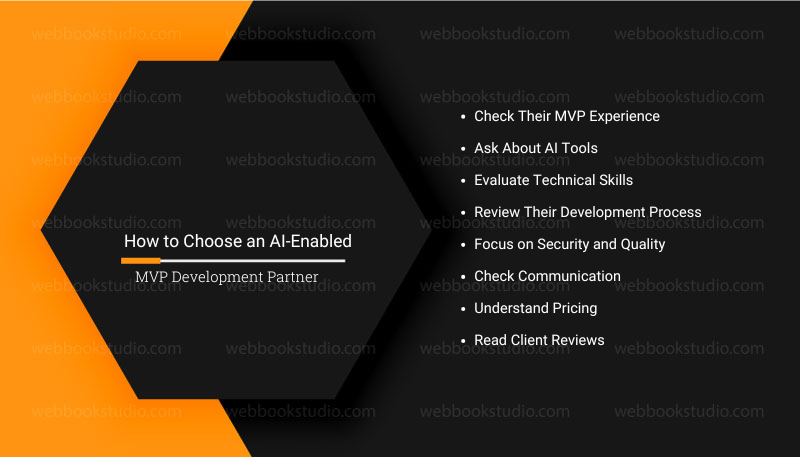
Choosing the right development partner is just as important as choosing the right AI tools. Look for a team that combines AI with real development experience.
- Check Their MVP Experience: Review their portfolio to see if they have built MVPs for startups in your industry.
- Ask About AI Tools: Find out which AI tools they use for planning, design, coding, testing, and deployment.
- Evaluate Technical Skills: Make sure the team has experience with web applications, mobile apps, SaaS products, cloud infrastructure, APIs, and scalable software development.
- Review Their Development Process: Choose a partner that follows Agile development, validates ideas early, and improves the product using user feedback.
- Focus on Security and Quality: Ask how they review AI-generated code, perform quality assurance, and protect user data.
- Check Communication: Select a team that provides regular updates, clear timelines, and responds quickly to questions and feedback.
- Understand Pricing: Request a detailed estimate that explains development costs, project scope, and ongoing support.
- Read Client Reviews: Look for testimonials and case studies that show successful MVP launches and satisfied startup clients.
A reliable AI-enabled MVP development partner uses AI to improve speed and efficiency while relying on experienced developers to deliver a secure, scalable, and high-quality product.
Conclusion: How Can AI and Developers Work Together to Build a Better MVP?
AI is changing MVP development for startups by making the process faster, more cost-effective, and more efficient. From idea validation and market research to coding, testing, and product improvements, AI helps startups launch an MVP with less time and fewer resources.
However, AI works best as a support tool, not a replacement for experienced developers. Human expertise is still needed for product strategy, custom development, security, performance, and scalability.
For startups, the best approach is to combine AI with a skilled development team. This allows you to validate ideas quickly, collect real user feedback, improve product-market fit, and build a strong foundation for future growth. By using AI wisely, startups can reduce risk, speed up time to market, and create products that better meet customer needs.
Most helpful article: Top 5 MVP App Development Mistakes and How to Avoid Them.
FAQs: How Can AI Help Startups Launch an MVP Faster?
1. Can AI build an MVP without developers?
AI can generate code, create designs, and automate testing, but experienced developers are still needed for custom features, security, scalability, and quality assurance.
2. How does AI reduce MVP development costs?
AI automates repetitive tasks such as research, coding, documentation, and testing. This reduces development time and helps startups use their budget more efficiently.
3. Is AI-powered MVP development suitable for every startup?
Yes, AI can benefit most startups. However, businesses with complex workflows or advanced technical requirements still need experienced developers to build a reliable product.
4. What are the best AI tools for MVP development?
Popular AI tools include ChatGPT for planning, GitHub Copilot and Cursor for coding, Figma AI for UI/UX design, Bolt.new and Lovable for app generation, and Firebase Studio for backend development.
5. Can AI improve product validation?
Yes. AI analyzes market trends, customer research, and user feedback to help startups validate ideas and make better product decisions before investing in full-scale development.
6. How long does AI-powered MVP development take?
The timeline depends on the project’s complexity. A simple MVP can often be built in a few weeks, while more advanced products may take several months. AI helps shorten the process by automating many development tasks.
7. Should startups use AI or traditional development?
The best choice is to combine both. AI increases speed and efficiency, while experienced developers ensure the MVP is secure, scalable, and meets business goals.