

How Do You Build an MVP Without Wasting Time and Money?
MVP app development is supposed to help startups launch faster, save money, and validate a core idea. To build an MVP (Minimum Viable Product) without wasting time or money, focus on a single core problem for a specific audience and prioritize only essential features.
MVP app development is preparing the simplest version of your application that delivers core value, tests market fit, and sparks growth. Start here to avoid plunging cash into unproven ideas, and it’s how 80% of unicorns were validated first.
Using low-code tools and validating your idea with real users early and often. Gather feedback to quickly repeat, track key metrics to measure success, and design a simple user experience instead of building a feature-rich product from the start.
But in reality, many founders still end up wasting budget and struggling with feature overload. MVP (Minimum Viable Product) app development is a strategy to launch a new application with only the most essential features to test a core idea with real users and gather feedback, which informs future development.
This approach allows for faster time-to-market, reduces initial investment, and validates the app’s concept and market fit with minimal risk. Key steps involve defining the purpose, identifying core features, designing the user experience (UX), coding the essentials, and launching to learn from user data.
Choosing the wrong mobile app development team, or building an overengineered MVP that users don’t even want. If you’re working on your first mobile app, debating whether to go cross-platform, low-code, or fully custom, or trying to understand the real meaning of MVP in app development, you’re not alone.
Clarifying the Foundation: What Does an MVP Really Mean in App Development?
Before you can avoid the biggest mistakes in MVP app development, you need absolute clarity on what an MVP truly is and what it is not. A Minimum Viable Product (MVP) isn’t a “cheap version” of your mobile or web app, nor is it a fully polished iOS or cross-platform solution packed with every feature you can imagine.
The global MVP development market clocked in at about $288 million in 2024 and is on track to hit around $315 million in 2025, with projections pushing it to $345 million by 2026 at a steady 9.5% compound annual growth rate (CAGR).
That’s not pocket change; it’s a sector fueled by startups hungry for validation in an era where 90% of them fail due to poor market fit. However, different reports provide varying figures; some sources state the market was around US$288-316 million in 2024 and is expected to grow to US$541-569 million by 2031.
The real MVP meaning in software development is simple, and it’s the smallest version of your product that solves one core problem for one defined audience, allowing you to test assumptions quickly, gather user feedback, and guide future development using real-world data instead of guesswork.
In mobile app and web development, an MVP exists to validate your idea with essential features only, not advanced functionality, complex UX flows, or heavy coding architectures that burn through your limited budget. MVP development for startups focuses on learning and practicing MVP app development.
Does the market actually need your solution? Are users willing to try it? Does the current experience solve their problem well enough? This early validation reduces risk, prevents feature overload, and ensures you don’t build an overengineered MVP that fails before you can scale it.
Why MVPs Fail More Often Than They Succeed, And Problem Awareness?
These aren’t just “rookie errors”; they are the exact reasons why most early iOS or web MVPs fail long before reaching product-market fit. Maybe you’re facing a limited budget, confused by what the minimum viable product should include, overwhelmed by feedback, or unsure how to avoid feature overload while still delivering value.
The good news? Every mistake has a predictable cause and a proven solution. How to avoid the most damaging pitfalls from choosing the right MVP app development company to validating your core idea, prioritizing essential features, gathering real user feedback, and developing a lean, scalable MVP that grows the right way.
Most teams start strong but quickly fall into common mistakes that can be avoided, it as skipping market research, ignoring user experience design, under-prioritizing scalability, neglecting security, or launching without proper prototyping, testing, analytics, or a clear product strategy.
The User Journey Breakdown Before Building the MVP.
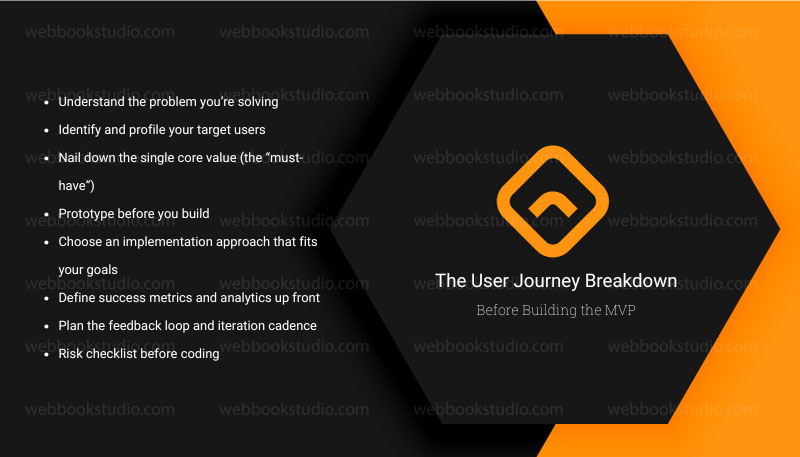
Before you write a single line of code or hire an MVP app development company, walk the full user journey. Doing so reduces the risk of feature overload, wasted budget, and building an overengineered MVP that fails to find users. Here’s a step-by-step breakdown that maps your idea to a testable MVP.
1. Understand the problem you’re solving
- Define the core problem in one sentence. Who has the problem (target users / early adopters) and why does it matter?
- Use market research (surveys, competitor analysis, trend scans) to validate that the problem is real and worth solving.
- Output: a one-page problem statement and at least three real user pain points.
2. Identify and profile your target users
- Create 2–3 user personas (age, context, goals, frustrations). These guide UX decisions and feature prioritization.
- Decide your launch audience, e.g., a small cohort of early adopters rather than “everyone.”
- Output: persona cards and a prioritized user segment to target for initial validation.
3. Nail down the single core value (the “must-have”)
- Ask: “What single action would make a user say ‘yes, that solves my problem’?” That action defines the minimum feature set.
- Use the MoSCoW technique (Must, Should, Could, Won’t) to categorize features and avoid feature creep.
- Output: a one-screen feature map listing only the Musts for the MVP.
4. Prototype before you build
- Build low-fidelity wireframes and then clickable prototypes (Figma, Adobe XD, or no-code prototyping tools).
- Test prototypes with real users to catch UX issues early (this prevents costly rework in code).
- Output: validated prototype and a prioritized fix list for the MVP UI.
5. Choose an implementation approach that fits your goals
- Evaluate tradeoffs: native (iOS/Android) vs cross-platform vs no-code/low-code. Consider budget, timeline, and required UX fidelity.
- If rapid validation is the goal, low-code/no-code or hybrid approaches can prove the idea before heavy engineering.
- Output: selected tech approach and rationale (cost, speed, scalability).
6. Define success metrics and analytics up front
- Decide what “success” looks like: activation rate, retention on day 7, conversion to paid, number of validated hypotheses, etc.
- Integrate simple analytics: Event tracking, funnels from day one, don’t launch “blind.”
- Output: KPI dashboard plan and instrumentation checklist.
7. Plan the feedback loop and iteration cadence
- Create channels for user feedback: in-app surveys, interviews, support inbox, and analytics alerts.
- Prioritize feedback using impact vs effort and iterate in short sprints (lean/Agile).
- Avoid the two extremes: ignoring feedback or implementing every suggestion immediately.
- Use structured experiments (A/B tests) where possible.
- Output: backlog prioritization rules and a 2-4 week iteration plan.
8. Risk checklist before coding
- Market risk: validated with user interviews?
- UX risk: prototype tested?
- Technical risk: Proof of concept completed?
- Legal/security risk: basic security and privacy considered?
- Scalability risk: baseline architecture decisions documented?
Five Best MVP App Development Mistakes: Is Your Strategy Setting You Up for Failure?
Even pros slip, but knowing these traps and their antidotes can save your project. Each mistake stems from a flawed mindset chasing perfection over progress, or skipping the human element. Why they derail, with examples, then arm you with fixes. These aren’t theoretical are drawn from hundreds of post-mortems where teams lost momentum.
1st Mistake: The Feature Creep Trap and Packing in Too Many Features.
MVPs thrive on minimalism, one core value prop, solved elegantly. Overloading with bells and whistles dilutes focus, balloons budgets (up 50-100%), and confuses users, leading to 40% abandonment rates. Why? Users don’t engage with “nice-to-haves” until basics click; it’s Parkinson’s Law in action, work expands to fill time.
For example, A 2025 fintech startup built an MVP budgeting app with AI forecasts, social sharing, and gamification. Result? $150K spent, beta users baffled, zero retention. Contrast with Mint’s early MVP, just transaction tracking. It hooked users, iterated to millions.
Avoid and ruthlessly prioritize for Use the MoSCoW method (Must-have, Should-have, Could-have, Won’t-have). Limit to 3-5 features solving your first pain point. Prototype in Figma, test with 20 users via UserTesting.
So, set a “feature freeze” post-week 2; revisit only after 1,000 users. For services, bill extras as Phase 2 upsells keep clients happy, revenue flowing.
2nd Mistake: Skipping Thorough Market Research and Validation
MVP app development mistakes the hard truth that 35% of MVPs flop because founders assume demand without proof. Building in a vacuum ignores competitors, user needs, or trends like voice search rising 30% by 2026. It wastes 60% of dev time on unviable ideas.
Real-world hit Juicero’s $120M juicer app MVP ignored that users just wanted cheap squeezers, launched to mockery. Meanwhile, a 2024 U.S. e-learning MVP surveyed 500 teachers first, nailing pain points like offline access, hitting 50K downloads in a Month.
- How to sidestep: Dedicate Week 1 to research.
- Tools: Ahrefs for keyword volume (e.g., “budget tracker app” at 10K searches/month),
- Typeform surveys for willingness-to-pay: Validate with a landing page on Carrd, gauge sign-ups pre-build.
- Best reason: Data trumps intuition; aim for 40% positive intent from 100 respondents. For business pros, offer “Validation Audits” as a $2K entry service, and facts show it converts 70% to full MVP contracts.
3rd Mistake: Ignoring User Feedback Loops from Day One
Post-launch silence is death. Why? MVPs aren’t endpoints; they’re conversations. Without feedback, you iterate blindly, missing 80% of usability issues that cause churn. Users spot flaws devs miss, intuitive flows, bug hot spots.
Example for MVP App Development: A travel MVP app launched with slick maps but clunky booking. No in-app surveys? Users ghosted, reviews tanked to 2 stars. Slack’s MVP, however, baked in feedback prompts, evolving from an IRC clone to $27 $27 billion giant.
How to Fix it: Embed loops early. Use Hotjar for heatmaps, Intercom for chats. Launch to 100 beta users via Product Hunt; schedule weekly reviews.
Solution: Set KPIs like Net Promoter Score >7. If serving clients, include “Feedback Sprint” in contracts, analyze, report, and iterate. This builds loyalty; one agency saw 40% repeat biz from it.
4th Mistake: Underestimating Team Communication and Collaboration
- Silos kill speed: In small teams (3-5 ideal for MVPs), misaligned goals waste 20-30% of hours on rework. Because vague specs lead to mismatched expectations, devs build what they think, not what stakeholders need.
- Case in point: A remote EU team built an e-commerce MVP with backend-heavy features, ignoring mobile-first UX. Handoff gaps? Three-week delays, $30K overrun. Trello’s MVP succeeded via daily stand-ups, aligning a distributed crew.
- Counter it: Adopt tools like Slack/Jira for transparency. Write user stories: “As a user, I want feature so benefit.” Weekly syncs, async updates. For agencies, use shared Notion dashboards so clients see progress live.
- Pro tip: Start with a kickoff workshop defining success metrics. Agile teams ship 2x faster; make it your edge.
5th Mistake: Neglecting Scalability, Security, and Post-Launch Planning
MVPs feel temporary, but skimping here invites disasters. Why? Early security holes (e.g., data breaches) erode trust, costing 6x in recovery; unscalable code bloats later costs by 200%. Users expect enterprise-grade from day one, especially with 2026’s privacy focus.
Exhibit A health app MVP stored data unencrypted and was hacked, exposing 5K users. A lawsuit followed. Uber’s MVP, conversely, prioritized basic auth, scaling seamlessly.
Choose scalable stacks like AWS Lambda for serverless. Implement OAuth early. Plan post-launch Budget 20% for iterations, set roadmaps in Miro.
Solution: Audit with tools like OWASP ZAP. For services, bundle “Scale-Ready Blueprints” clients love the foresight, boosting referrals by 50%. Master these, and your MVPs won’t just launch, they’ll soar.
How to Build a Successful MVP: Step-by-Step Solution?
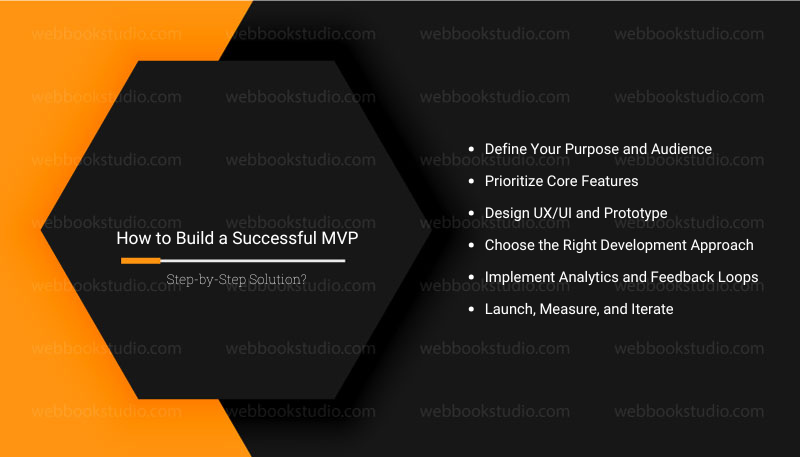
After understanding the top 5 MVP app development mistakes, it’s time to put the lessons into action. A successful Minimum Viable Product (MVP) isn’t just about launching fast, and it’s about learning quickly, validating your idea, and building the right product for your users.
Step 1: Define Your Purpose and Audience
- Clearly state the problem your mobile app solves
- Identify target users and early adopters
- Conduct market research to validate demand
- Output: a one-page problem statement and user personas
Step 2: Prioritize Core Features
- Focus on the “must-have” functionalities only
- Use frameworks like MoSCoW to avoid feature overload
- Align features with user feedback goals
- Output: a minimum feature set for MVP launch
Step 3: Design UX/UI and Prototype
- Build wireframes and clickable prototypes using Figma or low-code/no-code tools
- Test user experience design before coding
- Validate flows, screens, and interactions with real users
- Output: validated prototype and actionable improvements
Step 4: Choose the Right Development Approach
- Decide between native iOS/Android, cross-platform, or low-code/no-code MVP
- Select an MVP app development company or team with relevant expertise
- Consider scalability, security, and future iterations
- Output: tech stack, development team, and project plan
Step 5: Implement Analytics and Feedback Loops
- Track key metrics: retention, activation, engagement, and churn
- Gather user feedback through surveys, beta testing, or in-app tools
- Use data-driven insights to guide iterative improvements
- Output: KPI dashboard and backlog prioritization rules
Step 6: Launch, Measure, and Iterate
- Release MVP to a small user group first (early adopters)
- Collect feedback, analyze metrics and analytics, and identify what works
- Iterate rapidly in short sprints following Agile development or Lean Startup principles
- Output and updated MVP ready for broader release
Key Takeaways: MVP App Development Solution.
- Focus on core features and avoid feature creep
- Validate your idea with market research and user feedback
- Select the right team and tech approach to reduce risk
- Build scalable and secure infrastructure from the start
- Use metrics and analytics to guide iterative development
Following this step-by-step framework ensures your MVP app is not just a prototype, but a learning tool that drives real growth and prepares your startup for long-term success.
Conclusion: Build Smart, Learn Fast, and Avoid MVP Pitfalls
MVP app development is a powerful strategy for startups to launch faster, validate ideas, and minimize risk, but only if done correctly.
The global MVP (Minimum Viable Product) development market was valued at US$12.1 billion in 2023 and is projected to reach US$21.5 billion by 2033, with a Compound Annual Growth Rate (CAGR) of 13.8%.
The top mistakes we covered, skipping market validation, feature overload, ignoring user feedback, choosing the wrong development team, and neglecting scalability, monetization, or security, are common traps that can derail even the most promising mobile app.
The key takeaway is that an MVP isn’t just a product; it’s a learning tool. By focusing on the core features, prioritizing user experience design, conducting market research, implementing analytics, and iterating with user feedback, you set your product up for success.
Choosing the right MVP app development company, selecting an appropriate tech stack (native iOS/Android, cross-platform, or low-code/no-code), and planning for scalability and security ensures your Minimum Viable Product can grow into a full-fledged app without costly mistakes.
The purpose of an MVP is to test, learn, and improve. Launch small, gather actionable insights, and iterate quickly. Avoiding these common pitfalls not only reduces MVP app development cost but also strengthens your product strategy, ensures a better UX/UI experience, and increases the likelihood of achieving product-market fit.
By following this framework, your startup can confidently move from concept to a validated, scalable, and secure mobile app, while continuously learning from real user interactions and data. In the world of MVPs, smart planning and iterative learning are far more valuable than building too much, too fast.
Get a more informative article: The role of MVPs in simple app development.
FAQ About MVP App Development: What Should Every Founder Know Before Starting MVP App Development?
1. What does MVP mean in app development?
MVP stands for Minimum Viable Product. It is the smallest version of a mobile app or software product that solves a core problem for users. The purpose is to test assumptions, gather user feedback, and validate the product strategy before full-scale MVP app development.
2. What are the most common mistakes in MVP app development?
The top five MVP app development mistakes include:
- Skipping market research and early validation
- Feature overload or overengineering the MVP
- Ignoring user feedback after launch
- Choosing the wrong MVP app development company or team
- Failing to plan for scalability, security, or monetization strategy
Avoiding these ensures your mobile app stays lean, cost-effective, and aligned with real user needs.
3. How much does MVP app development cost?
Costs vary depending on:
- Complexity of core features
- Choice of platform (iOS, Android, cross-platform)
- Development approach (native vs low-code/no-code)
- Scope of UX/UI design, testing, and analytics
A lean MVP focuses on essentials to reduce MVP app development cost while still validating the idea.
4. What is MVP development for startups?
For startups, MVP development is a strategy to: Quickly test business ideas, gather user feedback, validate market need, minimize risk and budget, and Iterate using Agile development or Lean Startup principles. It allows startups to launch a Minimum Viable Product, learn fast, and scale smartly.
5. How do I choose the right MVP app development company?
Look for a team with proven experience in MVP Cross Platform App Development Services. Expertise in mobile apps, cross-platform, iOS/Android, or low-code/no-code solutions. Strong understanding of UX/UI design and product strategy. Knowledge of analytics integration, scalability, and security best practices. Positive reviews and a startup-focused experience, starting with the right team, help avoid feature creep, wasted budget, and delays.
6. How much does MVP development cost now?
Based on the chosen platform, the MVP development cost can be between $10,000 and $160,000. Businesses can choose to launch their MVP either on a single platform, across multiple platforms (iOS and Android), or as a cross-platform application.