

Website Redesign for Lead Generation: Turn Traffic Into High-Quality Leads in 2026.
Website redesign for lead generation is no longer just about making your business site look modern, but also fixing the hidden issues that silently kill your conversions.
Many businesses invest in Digital Marketing and drive traffic through campaigns, yet struggle to convert visitors into qualified leads because their websites aren’t aligned with User Experience Design (UX) or Conversion Rate Optimization (CRO) principles.
If your site has a high bounce rate, slow page speed, poor mobile responsiveness, or lacks clear call-to-action (CTA) elements, you’re not just losing visitors, you’re losing real business opportunities.
In today’s competitive digital world, especially for B2B marketing and B2B SaaS companies, a website must function as a complete lead generation engine, not just a digital brochure.
A strategic redesign focused on website usability, conversion funnels, and lead nurturing can transform underperforming pages into high-converting assets.
Is Your Website Killing Your Conversions? What You’re Missing
The solution isn’t simply adding more content or running more ads, but aligning your website structure, messaging, and design with how users actually behave and make decisions.
The numbers tell a clear story. Global web design services are valued near $61 billion in 2025 and climbing steadily, with the US market alone exceeding $48 billion in 2025 and heading toward $79 billion by 2032. Lead-generation software is expanding at double-digit rates, hitting around $6.4 billion in 2026.
That means building a seamless customer journey supported by responsive design, intuitive navigation, optimized landing pages, and effective lead capture forms.
When combined with strong Search Engine Optimization (SEO) technical performance improvements like Core Web Vitals, and data-driven strategies such as A/B testing, heatmaps, and funnel analysis, your website can actively guide users through a high-converting marketing funnel.
Using modern tools like Instapage or Leadpages, or working with a design agency to rebuild your site architecture. The goal remains a guide to create a conversion-focused experience that turns traffic into measurable leads.
The Role of UX, CRO, and SEO in Lead Generation
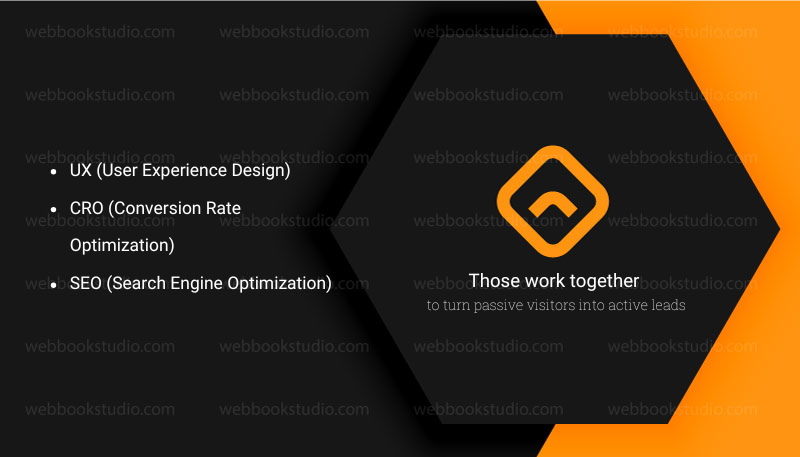
To truly understand why a website redesign for lead generation works, you need to see how the three core pillars,
- User Experience Design (UX)
- Conversion Rate Optimization (CRO)
- Search Engine Optimization (SEO)
Those work together to turn passive visitors into active leads.
1. UX (User Experience Design):
UX design determines how users interact with your website. A clean layout, intuitive navigation, responsive design, and fast-loading pages ensure visitors can easily find what they’re looking for. When your website aligns with user expectations and behavior, it reduces friction in the customer journey. This directly impacts engagement metrics such as session duration and bounce rate, both critical indicators of whether users stay long enough to convert.
2. CRO (Conversion Rate Optimization):
This focuses on turning that engagement into action. It’s not enough for users to browse need to take the next step. CRO is where elements like compelling call-to-action (CTA) buttons, high-converting landing pages, lead capture forms, and persuasive copywriting come into play. CRO ensures that every page on your site is strategically designed to guide users through a structured conversion funnel, whether that’s signing up, requesting a quote, or downloading a resource.
3. SEO (Search Engine Optimization):
Which brings the right audience to your website in the first place. By optimizing your site structure, content, and technical performance, Search Engine Optimization (SEO) helps attract high-intent users who are already searching for your products or services.
But SEO alone isn’t enough if your UX and CRO are weak; even highly targeted traffic won’t convert into leads.
The real power comes from integration. When UX creates a seamless experience, CRO drives action, and SEO delivers qualified traffic, your website becomes a complete lead generation system.
Add to that data-driven insights like heatmaps (Heat maps are data visualization tools that use color gradients to represent data density or magnitude, making it easy to identify hotspots, trends, and outliers at a glance.) A/B testing, funnel analysis, and you can continuously refine your strategy based on real user behavior.
In practical terms, this means your website is no longer just attracting visitors but actively guiding them through a well-optimized journey, from the first click to the final conversion.
Are You Losing Leads Because of Your Website? 10 Signs How Know?
Here are the 10 clearest signs it’s time for your site to get a serious upgrade. Each one comes with the logic behind why it hurts, leads, real-world examples, and practical fixes you can expect from a focused redesign.
1. Does Your Website Take Too Long to Load?
Every extra second of load time costs you visitors and money. Studies show that a one-second delay can slash conversions by up to 27%. People are impatient. They expect instant results on mobile or desktop.
- Why it kills leads: Slow sites frustrate users before they even read your headline. Google also penalizes slow pages in search rankings, so you lose organic traffic too.
- Real example: A mid-sized e-commerce retailer saw its cart abandonment rate drop sharply after shaving three seconds off load times. Monthly leads jumped because visitors actually stayed long enough to add items and request quotes.
- Redesign solution: Modern website redesign for lead generation starts with performance audits, compressing images, leveraging browser caching, and choosing lightweight code. The result? Faster experiences that keep users engaged and ready to convert.
2. Is Your Site Not Built for Mobile Users?
Over 60% of web traffic now comes from phones. If your layout breaks on smaller screens, you’re invisible to most potential customers.
- Logical reason: Non-responsive designs force zooming and pinching, which feels awkward and unprofessional. Users abandon sites that don’t work on their device of choice.
- Example in action: A professional services firm in the US watched its mobile conversion rate sit at 0.8% until a redesign made every form and CTA thumb-friendly. Leads from mobile traffic tripled within two months.
- Fix through redesign: Responsive layouts, touch-optimized buttons, and mobile-first navigation become standard. Mobile design-friendly directly feeds more leads into your sales funnel.
3. Are Bounce Rates Sky-High and Time on Site Too Low?
If visitors land, glance, and leave in under 30 seconds, your site isn’t holding attention.
- Why this matters: High bounce rates signal poor first impressions. People don’t trust or understand what you offer, so they never reach your lead forms.
- Data-backed insight: Average time on site below one minute often correlates with conversion rates under 2%. After redesigns focused on clear value propositions, businesses routinely see engagement double.
- Redesign approach: Strategic content hierarchy, compelling hero sections, and fast-scrolling layouts keep users reading and filling out forms.
4. Does Your Design Look Dated or Out of Step with Your Brand?
An outdated aesthetic screams, “We haven’t updated since 2018.” It erodes trust instantly.
- Reason: First impressions form in milliseconds. A modern, cohesive look builds credibility and makes your offer feel current and reliable.
- Case in point: Construction companies with text-heavy, old-school sites saw inquiries rise after switching to image-forward, video-backed designs that highlight real projects.
- Solution: Fresh branding integration, clean typography, and intentional white space turn browsers into believers and lead submitters.
5. Are Your Calls-to-Action Weak, Hidden, or Missing?
If visitors have to hunt for the “Contact Us” button or “Get a Quote” form, they won’t bother.
- Reasoning: Clear, benefit-driven CTAs guide behavior. Without them, even interested users remain undecided.
- Practical example: One B2B client doubled demo requests simply by placing prominent, action-oriented CTAs above the fold and repeating them strategically throughout the page.
- Redesign fix: Bold, contrasting buttons with persuasive copy like “Book Your Free Strategy Call Today” placed where users naturally look.
6. Is Navigation Confusing or Overwhelming?
Too many menu items or buried pages make users feel lost.
- Why it hurts: Frustrated visitors bounce. Simple, intuitive menus reduce cognitive load and speed users toward conversion paths.
- Redesign strategy: Logical information architecture, mega-menus where needed, and clear category labels that match how customers actually search.
7. Do You Lack Effective Lead Capture Tools?
No pop-ups, no forms, no chat widgets? You’re relying on hope instead of systems.
- Logic: Most visitors won’t call or email on the first visit. Smart capture tools meet them where they are and qualify interest without friction.
- Modern 2026 twist: AI chatbots that ask progressive questions and book meetings automatically have become game-changers for lead volume.
- Solution: Integrated forms, exit-intent pop-ups, and conversational tools embedded during the redesign.
8. Is Your Content Outdated or Poorly Optimized for Search?
Stale blog posts, broken links, or missing keywords mean you’re invisible to Google and to buyers researching solutions.
- Reason: Search drives the majority of high-intent traffic. Without fresh, SEO-friendly content, competitors steal your leads.
- Redesign opportunity: Content audits, pillar pages, and schema markup that help search engines and users find exactly what they need.
9. Does Your Site Feel Generic or Lack Personalization?
One-size-fits-all experiences no longer cut it. Visitors expect relevance.
- Why now? In 2026, dynamic content that changes based on visitor location, past behavior, or industry can dramatically lift engagement.
- Example: B2B sites using AI to show tailored case studies see higher quote requests because the content feels made for that exact visitor.
- Redesign benefit: Personalized journeys turn anonymous traffic into warm leads.
10. Are Your Conversion Rates Below Industry Averages?
If you’re stuck at 1-2% while peers hit 3-5% or higher, something is fundamentally broken.
- Fact check: Across industries, the average sits around 2.9%, but optimized sites routinely exceed that after targeted redesigns.
- Redesign payoff: Heatmap analysis, A/B testing frameworks, and conversion-focused layouts deliver measurable lifts often 47% or greater in lead quality and quantity.
Why Website Redesign for Lead Generation Is a Unique Idea in 2026?
This isn’t just another refresh. Website redesign for lead generation stands apart because it merges design excellence with revenue psychology. In 2026, trends like Agentic AI (websites that act on user intent), cookieless personalization, and micro-interactions create experiences that feel alive and helpful rather than salesy.
- Businesses that support it achieve an edge: faster load times meet accessibility standards, immersive elements keep users engaged longer, and privacy-first tools build trust in a post-cookie world.
- Real results speak volumes: Some companies report 250% more leads after focused redesigns that prioritize conversion paths over aesthetics alone.
If you recognize even a few of these signs, your small business website design packages may not be functioning as an effective lead generation tool. Instead of supporting your marketing efforts, it could be quietly limiting your growth, making a strategic redesign not just helpful, but necessary.
Website Redesign for Lead Generation: When to Redesign vs When to Optimize?
Not every underperforming website immediately needs a full rebuild. A successful website redesign for lead generation strategy starts with understanding whether you need a complete redesign or targeted optimization.
This decision is guided by how well your current site supports UX Design, Conversion Rate Optimization, and Search Engine Optimization goals.
| Criteria | Optimize Your Website | Full Website Redesign |
| Overall Condition | The website has a strong foundation, but minor issues | The website has structural, design, or performance problems |
| Design Quality | Modern design but low conversions | Outdated design with poor usability |
| User Experience | Minor User Experience Design issues affecting flow | Major UX problems causing confusion and drop-offs |
| Conversion Performance | Traffic is steady, but the conversion rate is low | Low conversions despite traffic and optimization efforts |
| Page Performance | Only specific pages (e.g., landing pages) underperform | The entire site struggles with engagement and performance |
| Mobile Responsiveness | Mostly responsive with small issues | Not mobile-friendly or poorly responsive |
| Navigation | Slight navigation improvements needed | Confusing or broken navigation structure |
| Lead Generation Elements | CTAs or forms need optimization | Missing or ineffective lead capture system |
| Technical SEO | Minor Search Engine Optimization fixes needed | Major technical issues affecting SEO and performance |
| Strategy Alignment | Mostly aligned with business goals | Not aligned with the current audience or marketing strategy |
| Recommended Actions | A/B testing, CTA improvements, landing page optimization, and content tweaks using Conversion Rate Optimization | Complete rebuild with improved UX, CRO, SEO, and conversion funnel structure |
| Impact Level | Quick wins and incremental improvements | Long-term transformation and scalable growth |
Ready to turn your site into a lead-generating machine? The right redesign doesn’t just look better performs better, month after month, year after year. Your future customers are already online. Make sure they find a website that knows exactly how to welcome them.
Simplified Strategic Difference Website Redesign for Lead Generation
Many businesses invest in Digital Marketing and drive traffic through campaigns, yet struggle to convert visitors into qualified leads because their websites aren’t aligned with User Experience Design or Conversion Rate Optimization principles.
| Approach | Core Focus |
| Optimization | Improves the existing structure for better performance |
| Redesign | Rebuilds the entire system for maximum lead generation |
If your website only has surface-level issues, optimization can deliver quick wins. But if it suffers from deeper UX, structural, or conversion challenges, a full redesign is essential to unlock consistent lead generation and long-term business growth.
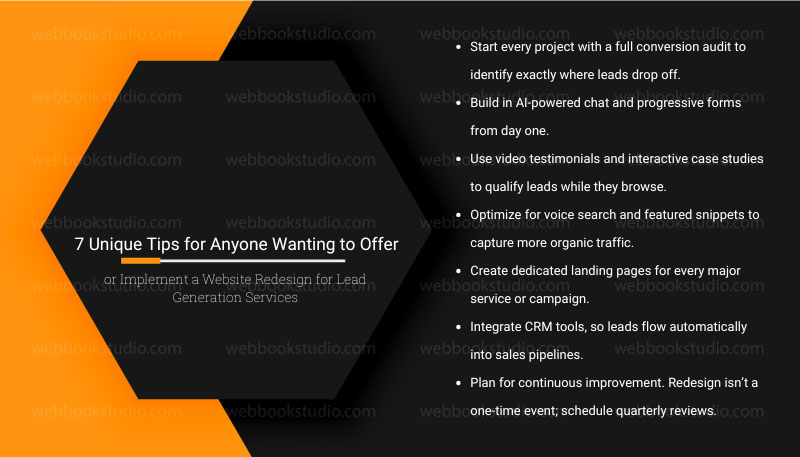
7 Unique Tips for Anyone Wanting to Offer or Implement a Website Redesign for Lead Generation Services
When done correctly, it improves visibility, engagement, and conversions, making your website one of the most powerful drivers of business growth.
- Start every project with a full conversion audit to identify exactly where leads drop off.
- Build in AI-powered chat and progressive forms from day one.
- Use video testimonials and interactive case studies to qualify leads while they browse.
- Optimize for voice search and featured snippets to capture more organic traffic.
- Create dedicated landing pages for every major service or campaign.
- Integrate CRM tools, so leads flow automatically into sales pipelines.
- Plan for continuous improvement. Redesign isn’t a one-time event; schedule quarterly reviews.
These tips turn a standard redesign into a high-ROI service that clients rave about. A website redesign is not just a visual upgrade, but a strategic investment.
Conclusion: Is Your Website Costing You Leads? 10 Signs You Need to Turn Traffic Into High-Quality Leads in 2026.
In 2026, your website isn’t just an online brochure your hardest-working salesperson, available 24/7. Yet millions of businesses still lose leads every day because their sites feel clunky, slow, or simply out of touch.
If visitors bounce before they even see your offer, or they can’t figure out how to contact you, you’re watching potential revenue walk away.
If your website is showing several of the warning signs discussed earlier clear that the issue is not just design performance, structure, and strategy.
A successful website redesign for lead generation is about rebuilding your digital foundation, so it actively supports growth rather than limiting it.
If your current website is not delivering results, the opportunity is not just to fix it but to transform it. A strategic redesign, supported by continuous optimization and data-driven improvements, can turn underperforming traffic into measurable business growth.
Turning your website into a lead generation engine. Your competitors are not just redesigning their websites for better looks but also for better conversions. The question is no longer “Does your website look good?” but “Is your website generating leads effectively?”
Most relevant article: Best Practices for Structuring Your Landing Page for Maximum Impact.
FAQs: Website Redesign for Lead Generation Getting Complete Guide to Higher Conversions & More Leads.
1. What is a website redesign for lead generation?
A website redesign for lead generation is the process of rebuilding or improving a website to increase the number of visitors who become leads. It focuses on improving structure, messaging, and conversion paths using principles from User Experience Design (UX), Conversion Rate Optimization (CRO), and Search Engine Optimization (SEO).
2. How do I know if my website needs a redesign?
You likely need a redesign if your website has a high bounce rate, low conversion rate, outdated design, poor mobile experience, or confusing navigation. These issues usually indicate that your site is not effectively supporting your lead generation goals.
3. What is the difference between website redesign and optimization?
Website optimization improves specific elements like CTAs, landing pages, or speed without changing the overall structure. A redesign, on the other hand, rebuilds the entire website structure, UX design, and conversion system to create a stronger foundation for long-term growth.
4. How does UX affect lead generation?
User Experience Design plays a major role in how users interact with your website. A clear layout, fast performance, and intuitive navigation reduce friction and guide users smoothly toward conversion points like forms or CTAs.
5. Why is CRO important in a website redesign?
Conversion Rate Optimization (CRO) ensures your website is not just attracting visitors but converting them into leads. It focuses on improving elements like landing pages, messaging, and call-to-action placement to maximize conversions.
6. Can SEO improve lead generation after a redesign?
Yes. Search Engine Optimization (SEO) helps bring targeted traffic to your website. After a redesign, improved site structure, speed, and content optimization can significantly increase both visibility and lead quality.
7. How long does a website redesign take?
The timeline depends on complexity, but most professional redesigns take a few weeks to a few months. It includes planning, UX design, development, testing, and optimization.