

Digital Marketing Consultant support may be necessary when your business is not getting the results expected from its online marketing efforts.
Common warning signs include declining website traffic, fewer qualified leads, poor conversion rates, unclear campaign performance, and marketing costs that fail to produce measurable results.
These problems can come from weak SEO, poor targeting, ineffective content, underperforming paid campaigns, or gaps in the customer journey.
A consultant can review your marketing channels, analytics, website performance, search visibility, and conversion data to identify where the strategy is failing.
In this article, we cover five clear signs that your business may need a Digital Marketing Consultant and explain how professional guidance can help identify marketing problems, improve performance, and develop a focused strategy aligned with measurable business goals.
What Is the Present Market Value of Digital Marketing Consulting?
Digital marketing consulting sits within the broader trading consulting sector.
Multiple industry analyses place the overall marketing consulting market in the tens of billions of dollars.
One detailed forecast estimates that it will be roughly USD 35.10 billion in 2025, rising to about USD 36.65 billion in 2026. Projected to grow toward USD 45.52 billion by 2031 at a compound annual growth rate near 4.4 percent.
Digital marketing consulting often accounts for the largest service slice, around 31% in recent data, because companies prioritize media measurement, search, paid channels, and customer experience in a privacy-constrained environment.
What Does a Digital Marketing Consultant Do?
A digital marketing consultant looks at your current online marketing efforts and helps identify what needs to improve.
Their work is not limited to one channel. They may review your SEO, website, content, social media, paid advertising, analytics, and conversion process.
A consultant may help your business:
- Review your current digital marketing strategy
- Identify gaps in SEO and content
- Understand your target audience
- Choose the right marketing channels
- Improve website traffic and conversions
- Track important marketing KPIs
- Review campaign performance and spending
- Find opportunities to improve customer acquisition
The exact work depends on your business goals and current problems. For some businesses, the main need may be better Search Engine Optimization (SEO). For others, it may be improving a website that receives traffic but generates few leads.
The goal is to understand what is not working, why it is happening, and what should be improved next. This gives your business a clearer direction instead of relying on trial and error.
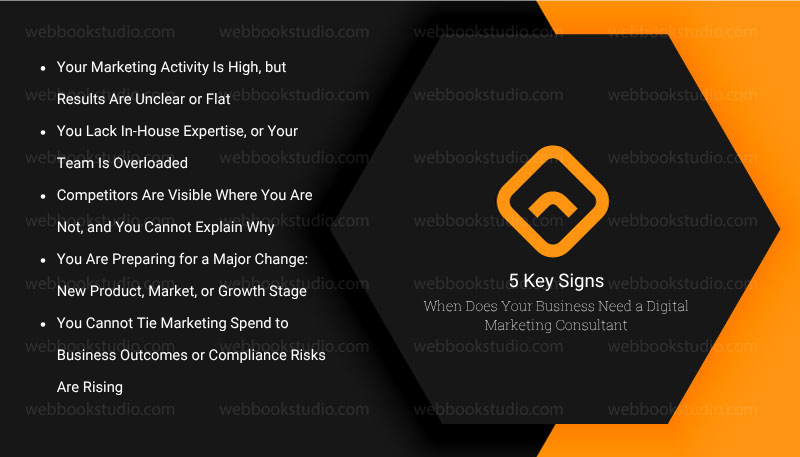
5 Key Signs: When Does Your Business Need a Digital Marketing Consultant?
You may not need outside help for every marketing problem. A consultant can be useful when your business has a clear marketing challenge, but your current team does not have the time, experience, or strategy to address it.
Before hiring anyone, identify the specific problem you want to solve. This makes it easier to choose the right type of support and set measurable goals from the beginning. Those five signs guide next steps.
Sign 1: Your Marketing Activity Is High, but Results Are Unclear or Flat
Many businesses produce content, run ads, post regularly, and send emails, yet leadership cannot answer a simple question.
Which activities actually drove revenue or qualified leads last quarter? Reports show rising impressions or follower counts, but pipeline and sales stay flat or decline.
This happens because activity is not the same as strategy. Without clear goals, audience definition, channel prioritization, and attribution, effort scatters.
Teams optimize for vanity metrics that look good in weekly updates but do not move the commercial needle.
In competitive markets, this pattern compounds and budgets rise while cost per acquisition climbs and conversion rates stagnate.
A digital marketing consultant typically begins with a full audit of channels, tracking, messaging, and conversion paths.
They map current activity against business objectives, identify the highest-leverage opportunities, and install measurement that ties marketing to revenue.
For example, a mid-sized U.S. service firm spending heavily on social ads and blog content might discover that most high-intent traffic arrives via branded search and referrals, while paid social mainly drives low-quality leads.
Redirecting budget and tightening landing pages can lower cost per lead within one or two quarters.
Solution path: Demand a baseline audit focused on commercial metrics. Set 90-day targets tied to pipeline or revenue contribution rather than traffic alone. Review progress against those targets, not activity volume.
Sign 2: You Lack In-House Expertise, or Your Team Is Overloaded
Small and mid-sized businesses often ask existing staff to “handle marketing” on top of their core roles. Founders make channel decisions by default.
Specialists in SEO, paid media, email automation, or Google Analytics are missing. As platforms change and privacy rules tighten, the knowledge gap widens.
Overloaded teams prioritize urgent daily tasks over strategic planning, testing, and optimization. They may keep campaigns running but rarely improve them.
When a new product launches or the company expands into a new market, the internal capacity simply cannot stretch further without quality suffering.
A consultant supplies specialized knowledge on demand without the fixed cost of multiple full-time hires. They can train internal staff, document processes, and leave systems that the team can maintain.
In one common scenario, a growing e-commerce brand sees rising ad costs and declining return on ad spend.
An external specialist audits audience targeting, creative testing, and landing-page experience, then implements structured experiments that recover efficiency while transferring knowledge to the in-house marketer.
Solution path: Inventory current skills against the channels that matter most for your business. Calculate the opportunity cost of delayed optimization.
Engage a consultant for a defined project or fractional role rather than permanent headcount until the need stabilizes.
Sign 3: Competitors Are Visible Where You Are Not, and You Cannot Explain Why
When competitors consistently appear higher in search results, dominate relevant social conversations, or capture more share of voice in your category, the gap is rarely accidental.
They usually have clearer positioning, stronger technical foundations, more relevant content, or better-paid media execution.
Internal teams may notice the difference but lack the time or analytical tools to reverse-engineer the causes. Without competitive intelligence, businesses react late, copying tactics after the window of advantage has closed.
A digital marketing consultant conducts structured competitor analysis across search visibility, content themes, paid strategies, messaging, and conversion approaches.
They identify specific gaps (missing service pages, weak topical coverage, poor mobile experience, outdated tracking) and prioritize fixes that close the distance fastest.
For a local professional services firm in the United States, this might mean building location-specific pages with proof elements, improving Google Business Profile (GBP) signals, and launching intent-matched paid campaigns that competitors have under-invested in.
Solution path: Request a competitive landscape review focused on the channels that drive your highest-value customers. Translate findings into a prioritized 6–12 month roadmap with clear ownership and success metrics.
Sign 4: You Are Preparing for a Major Change: New Product, Market, or Growth Stage
Launching a new product line, entering a new geographic market, raising capital, or shifting from referral-only growth to scalable acquisition all increase marketing complexity.
Existing tactics that worked at a smaller scale often break. Messaging needs refinement. New audiences require different channels and proof points. Measurement must expand.
Businesses that try to stretch current approaches risk wasted spend and slower traction. Those that bring in external perspective early design the go-to-market system properly from the start.
A consultant helps define the ideal customer profile for the new initiative, select channels, craft messaging hierarchies, build measurement frameworks, and sequence activities so early results inform later investment.
A B2B software company expanding from the U.S. domestic market into Europe, for instance, needs localized content, privacy-compliant data practices, and adjusted paid strategies. An experienced consultant shortens the learning curve and reduces costly missteps.
Solution path: Treat major transitions as strategy projects, not pure execution. Bring a consultant in during planning rather than after launch when problems appear.
Sign 5: You Cannot Tie Marketing Spend to Business Outcomes or Compliance Risks Are Rising
If leadership asks “what did we get for the marketing budget?” and the answer is unclear, the organization has an attribution and accountability problem.
In parallel, privacy regulations, consent requirements, and platform policy changes raise compliance stakes. Continuing to rely on outdated tracking or third-party data without a first-party strategy creates both performance and legal exposure.
This combination is increasingly common as AI tools generate more content and campaigns while data quality remains poor. Fragmented customer data limits personalization and makes AI less effective.
A digital marketing consultant rebuilds tracking and attribution around consented first-party data, establishes clear KPIs linked to revenue, and designs privacy-respecting collection and activation processes.
They help shift from vanity reporting to decision-grade insights. Businesses that complete this transition typically gain clearer budget allocation and higher confidence in scaling successful channels.
Solution path: Start with a measurement and data audit. Prioritize fixing consent, tracking, and first-party data foundations before expanding spend. Use the improved visibility to reallocate budget toward proven drivers of pipeline and revenue.
Digital Marketing Consultant vs Agency vs In-House Marketer
Businesses can choose different types of digital marketing support. The main difference is the level of strategy, execution, and internal involvement each option provides.
| Option | Main Focus | Best For | Typical Support |
| Digital Marketing Consultant | Strategy and guidance | Businesses that need direction or expert advice | Marketing audits, strategy, SEO guidance, analytics, KPIs, and recommendations |
| Digital Marketing Agency | Ongoing marketing execution | Businesses that need support across several channels | SEO, content, social media, paid advertising, and campaign management |
| In-House Marketer | Internal marketing management | Businesses with regular marketing needs | Daily marketing tasks, content, campaigns, reporting, and coordination |
A Digital Marketing Consultant may be useful when you know your marketing needs improvement but are not sure what is causing the problem.
An agency may be more suitable when you need ongoing execution, while an in-house marketer can manage marketing activities as part of your internal team.
The right option depends on your business goals, budget, internal skills, and the type of marketing support you need.
What Results Can a Digital Marketing Consultant Help With?
A Digital Marketing Consultant does not guarantee a fixed number of leads, sales, or search rankings. Results depend on your industry, competition, website, budget, audience, and the work that is implemented.
However, professional guidance can help your business work toward measurable improvements such as:
| Area | Possible Improvement |
| SEO | Better keyword targeting and stronger search visibility |
| Website | Clearer user experience and conversion paths |
| Content | Content that better matches audience needs and search intent |
| Paid Advertising | Better campaign structure and budget tracking |
| Analytics | Clearer performance data and marketing KPIs |
| Lead Generation | Better processes for turning relevant visitors into leads |
| Strategy | A more organized approach to digital marketing |
The most useful results should be connected to your business goals. Instead of focusing only on website traffic or social media engagement, track meaningful metrics such as qualified leads, conversions, customer acquisition, and return on marketing investment.
This gives you a clearer way to understand whether your digital marketing efforts are supporting your business objectives.
7 Common Mistakes to Avoid When Hiring a Digital Marketing Consultant
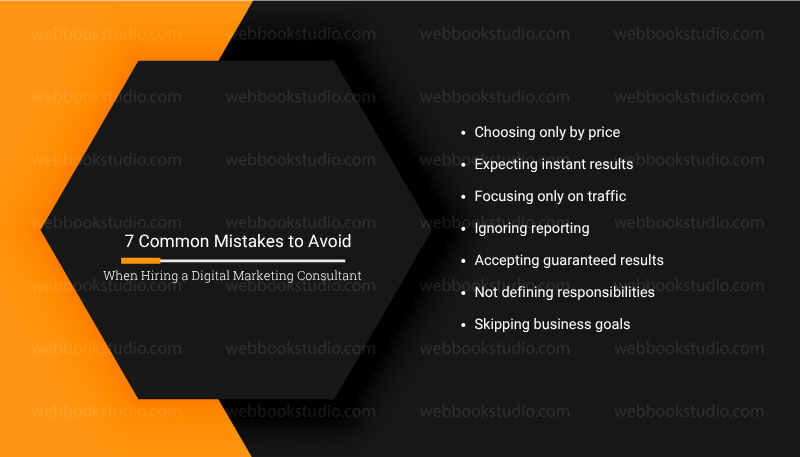
Choosing a consultant based only on price or promises can create problems later. Before starting a project, look beyond the cost and understand how the consultant plans to approach your marketing needs. The seven most common mistakes include:
- Choosing only by price: The lowest fee may not provide the level of expertise or support your business needs.
- Expecting instant results: SEO, content, and other marketing activities often require time and consistent implementation.
- Focusing only on traffic: More visitors do not always mean more qualified leads or customers.
- Ignoring reporting: Without regular performance data, it is difficult to understand what is working.
- Accepting guaranteed results: Be cautious of promises for guaranteed rankings, leads, or sales.
- Not defining responsibilities: Make sure you know what the consultant will handle and what your team must implement.
- Skipping business goals: Marketing recommendations should connect with your actual business objectives.
A clear agreement, realistic goals, regular communication, and measurable KPIs can make the consulting process easier to manage and evaluate.
How to Prepare Before Meeting a Digital Marketing Consultant
You can get more value from a consultation by preparing basic information about your current marketing. You do not need advanced marketing knowledge. Simple business data can help the consultant understand your situation faster.
Prepare before meeting:
- Business goals: Explain what you want to achieve, such as more leads, sales, or online visibility.
- Target audience: Share who your main customers are and what they need.
- Current marketing channels: List the SEO, social media, content, email, or paid advertising activities you currently use.
- Website information: Provide access to relevant analytics and performance data when appropriate.
- Previous campaigns: Share what you have tried and what results you observed.
- Marketing budget: Give a realistic budget range so recommendations can match your resources.
- Main challenges: Clearly explain the problems you want to solve.
Having this information ready gives the consultant a clearer starting point. It also helps keep the discussion focused on your actual business needs instead of using a generic marketing strategy.
Digital Marketing Consultant Checklist
Before deciding if your business needs professional marketing support, review these areas:
| Business Situation | What to Check |
| Low website conversions | Are visitors taking the actions you want? |
| Poor search visibility | Are your important pages targeting relevant search terms? |
| Unclear marketing strategy | Are your marketing activities connected to specific goals? |
| Unmeasured performance | Are you tracking leads, conversions, and other useful KPIs? |
| Limited team resources | Does your team have enough time and expertise to manage marketing? |
| Wasted marketing budget | Can you identify which channels are producing meaningful results? |
| Slow business growth | Are your current digital marketing activities supporting your business goals? |
If several of these situations apply to your business, reviewing your current strategy can help you identify where professional guidance may be useful.
Start with the biggest problem, define a measurable goal, and then decide what type of marketing support fits your needs.
Conclusion: Do Signs to Know Your Business Needs a Digital Marketing Consultant?
Knowing when to get professional marketing support can help you avoid wasting time and budget on activities that are not moving your business forward.
If your website gets traffic but few leads, search visibility is low, marketing lacks direction, results are difficult to measure, or your team does not have enough time or expertise, it may be worth reviewing your current approach.
A Digital Marketing Consultant can help identify gaps, set clear priorities, choose suitable marketing channels, and create a plan based on your business goals. The right support should focus on measurable objectives rather than simply increasing traffic or activity.
Before making a decision, review your current marketing performance and identify the main problem you want to solve. This gives you a stronger starting point for deciding if consulting support is the right next step for your business.
Relevant article: Why your business needs a professional brand identity package?
FAQs: Are Your Marketing Efforts Falling Short?
1. What does a Digital Marketing Consultant do?
A Digital Marketing Consultant reviews a business’s online marketing activities and recommends ways to improve them. This may include SEO, content, social media, paid advertising, website performance, analytics, and conversion strategies.
2. When should a business hire a Digital Marketing Consultant?
A business may consider hiring a consultant when marketing results are unclear, website traffic does not generate enough leads, search visibility is low, or the internal team lacks the time or expertise to manage digital marketing effectively.
3. How is a Digital Marketing Consultant different from an agency?
A consultant generally focuses on strategy, analysis, and guidance, while an agency often provides ongoing execution across multiple marketing channels. The right option depends on the business’s goals, resources, and marketing needs.
4. Can a Digital Marketing Consultant improve website traffic?
A consultant can identify opportunities to improve SEO, content, keyword targeting, and other traffic sources. However, traffic results depend on factors such as competition, website quality, industry, content, and implementation.
5. How long does it take to see digital marketing results?
There is no fixed timeframe for every business. Results can vary based on the marketing channel, competition, website condition, budget, and consistency of implementation. SEO and content marketing, for example, may require ongoing work before meaningful changes become visible.
6. What should I ask before hiring a Digital Marketing Consultant?
Ask about their experience, working process, recommended marketing channels, KPIs, reporting methods, responsibilities, and how they plan to understand your business goals. Avoid relying only on promises of guaranteed rankings, leads, or sales.
7. How much does a Digital Marketing Consultant cost?
Consulting fees vary based on experience, project scope, business needs, and the level of support required. Before agreeing to a fee, clarify the services included, expected deliverables, reporting, and payment structure.
8. Can a small business benefit from a Digital Marketing Consultant?
Yes. A small business may use consulting support to identify marketing gaps, prioritize limited resources, improve online visibility, and create a clearer strategy without immediately building a large internal marketing team.