

How Does Data Analysis Strengthen Your E-Commerce Marketing Strategy?
Web analytics in digital marketing has become the backbone of every successful e-commerce business, especially as brands struggle to understand why traffic isn’t converting, why cart abandonment keeps rising, or why certain marketing campaigns fail to generate consistent sales.
Data analysis strengthens e-commerce marketing by enabling data-driven decisions that improve customer understanding, personalize shopping experiences, optimize marketing campaigns, and enhance overall strategy.
By analyzing customer behavior, sales trends, and campaign performance, businesses can refine marketing efforts, improve website design, and increase conversions and customer retention
With so much big data flowing through every eCommerce platform, many store owners feel overwhelmed, unsure how to interpret it or how to turn raw numbers into actionable insights. That’s where a structured, data-driven strategy changes everything.
By using advanced e-commerce data analytics tools like Google Analytics, heatmaps, and multi-channel attribution dashboards, businesses can improve data tracking, uncover hidden user behavior patterns, and optimize every part of their e-commerce website.
Suppose you’re a marketer refining your marketing strategy. In that case, a data analyst is diagnosing performance drops, or a business owner is aiming for predictable revenue growth.
Predictive analytics, customer segmentation, and detailed data analysis provide clear answers to your biggest challenges.
From improving product performance to boosting conversions across e-commerce marketing strategies, leveraging accurate analytics helps you personalize user experiences, refine marketing campaigns, reduce friction at checkout, and build a smarter e-commerce strategy that adapts to customer needs.
Dive deep into best practices tailored for e-commerce, explore why this field is poised for explosive growth by 2026, and break down the market’s value, required skills, and actionable solutions. You’ll have a roadmap to turn raw data into revenue.
What Exactly is Web Analytics in Digital Marketing?
Have you ever paused to think about how giants like Amazon know exactly what to recommend next?
It’s not magic, it’s the power of web analytics in digital marketing: the systematic collection, analysis, and interpretation of data from your website and online campaigns to inform business decisions.
At its core, web analytics tracks how users interact with your digital assets. For e-commerce, this means monitoring everything from traffic sources to purchase funnels.
Tools like Google Analytics (free and widely used) or advanced platforms like Adobe Analytics capture metrics such as page views, bounce rates, and session duration.
The logic here is straightforward, and without these insights, marketing efforts are like shooting arrows in the dark. Data reveals patterns, say, 70% of your traffic comes from mobile but converts poorly on checkout pages, allowing targeted fixes that can lift sales by 20-30%, based on real-world benchmarks from Shopify merchants.
Why does this matter globally? In the U.S., where e-commerce penetration hit 22% of retail in 2025, analytics helps comply with privacy regs like CCPA while personalizing experiences.
Worldwide, in markets like India or Brazil, where mobile shopping surges, it uncovers cultural nuances, like preferring voice search over text. The reason it’s transformative, that it shifts marketing from guesswork to evidence-based strategy, ensuring every dollar spent yields measurable ROI.
By analyzing cart abandonment data, they identified slow load times as a culprit and optimized their site, reducing drop-offs by 15% and adding millions to annual revenue. That’s the real-world proof: Web analytics in digital marketing isn’t abstract, and it’s the bridge between visitor intent and your bottom line.
What Is Web Analytics in E-Commerce?
Web analytics in e-commerce refers to the process of collecting, measuring, and interpreting data from your e-commerce website to understand how visitors behave and what influences them to buy or leave.
At its core, web analytics transforms raw data tracking into meaningful insights that help marketers, business owners, and data analysts make smarter decisions. This includes analyzing traffic sources, customer behavior, product performance, and how different marketing campaigns contribute to overall sales.
In the world of digital marketing, analytics acts as the central nervous system of your marketing strategy, connecting information from various e-commerce platforms, ad channels, and user journeys.
Tools like Google Analytics, attribution dashboards, and other e-commerce data analytics tools allow businesses to dive deeper into data analysis, identify friction points, and evaluate how users interact with product pages, carts, and checkout flows.
When layered with advanced techniques like segmentation, predictive analytics, and CLV modeling, analytics offers a complete, data-driven picture of what truly drives revenue.
Ultimately, e-commerce web analytics helps you move beyond guesswork, empowering your team to optimize the customer experience, refine e-commerce marketing strategies, and build a stronger, growth-focused e-commerce strategy grounded in real data rather than assumptions.
Best Practices for Implementing Web Analytics in E-Commerce

Diving into web analytics in digital marketing can feel overwhelming, but starting with solid best practices turns chaos into clarity. For e-commerce, the goal is to create a data-driven feedback loop that refines your digital marketing tactics. Let’s break it down step by step, with the reasoning and examples to show why each practice delivers results.
1. Web Analytics in Digital Marketing: Choose and Set Up the Right Analytics Tools.
Why start here, web analytics in digital marketing? Because of poor tool selection leads to incomplete data, like trying to navigate with a foggy map. E-commerce demands tools that integrate seamlessly with your platform, like WooCommerce or BigCommerce, and handle high-volume traffic without glitches.
Opt for Google Analytics 4 (GA4), the gold standard for beginners. It’s free, scalable, and AI-powered for predictive insights. Setup involves adding a tracking code to your site’s header, then configuring events like “add to cart” to monitor micro-conversions. For advanced users, layer in Hotjar for heatmaps or Mixpanel for user segmentation.
For Example, A U.S.-based fashion brand, Everlane, integrated GA4 with its Shopify store in 2024. They tracked cross-device journeys, discovering 40% of users started on mobile but converted on desktop. This led to unified campaigns, boosting repeat purchases by 25%. Worldwide, a Brazilian coffee e-tailer used a similar setup to tag geo-specific events, tailoring promos for São Paulo vs. Rio, increasing regional sales 18%.
The reason web analytics in digital marketing tools is set up and works: Proper setup ensures 100% data accuracy, avoiding the common pitfall of underreported traffic that skews budgets.
2. Track Key Metrics That Drive E-Commerce Growth
What metrics should you prioritize? Not everything focuses on those tied to revenue. Bounce rate tells engagement health and conversion rate measures funnel efficiency, and customer lifetime value (CLV) predicts long-term profitability.
E-commerce thrives on attribution, knowing which channel, email, SEO, or PPC sparks sales. Track acquisition via UTM parameters in links, then segment by device or source. Tools auto-calculate ROAS (return on ad spend), but manual benchmarks ensure relevance.
Web analytics in digital marketing: Unlocking eCommerce success with proven best practices. Take metrics one by one:
- Traffic Sources: 60% of U.S. e-commerce traffic is organic/search-driven. It reveals SEO vs. paid ad efficacy. For example, Warby Parker analyzed sources and shifted 30% budget from underperforming Facebook to Google, lifting traffic 22%.
- Conversion Rate Optimization (CRO): Aim for a 2-5% industry average. Use A/B testing on CTAs. A UK electronics site tested “Buy Now” vs. “Add to Bag,” seeing a 12% uplift, proving small tweaks yield big wins.
- Cart Abandonment: Averages 70% globally. Track exit pages and reasons, including high shipping costs. For Solution, exit-intent popups with discounts, as done by ASOS, recover 15% of lost sales.
By monitoring these, you create a dashboard in Google Data Studio, visual, shareable, and updated in real-time for weekly reviews.
3. Analyze and Act on User Behavior Patterns
Ever wondered why users linger on a product page but flee at checkout? Behavior analysis uncovers these “why” moments, using session replays and flow reports.
The reasoning for analyzing users’ behavior patterns will surface-level metrics, miss the story, and web analytics in digital marketing deep dives reveal friction points. Segment users (new vs. returning) to personalize logic, being tailored experiences boost retention 20-30%.
Web analytics in digital marketing example: Nike’s e-commerce team used behavior heatmaps to spot thumb-unfriendly mobile buttons, redesigning for better UX and increasing mobile conversions by 35%. In Asia, Lazada analyzed scroll depth, optimizing infinite scroll for longer sessions, upping average order value by 14%.
Act with segmentation: High-intent users (viewed 5+ pages) get nurture emails. Tools like Segment.io unify data across apps, ensuring holistic views.
4. Integrate Web Analytics In Digital Marketing With Broader Digital Marketing Strategies
Siloed analytics wastes potential. Why integrate? It enables omnichannel attribution, where email clicks influence social buys.
Modern buyers hop platforms, tracking cross-channel paths, attribute value accurately, and optimizing budgets. Use server-side tracking for privacy compliance.
Case study: Sephora linked GA4 to Klaviyo for email analytics, tracing 25% of sales to personalized flows based on browse data. Globally, Alibaba integrates with WeChat, analyzing mini-program interactions to refine live-stream shopping, a trend exploding in China.
Best practice web analytics in digital marketing: Set quarterly goals, like 15% ROAS improvement, and A/B test integrations.
In today’s competitive AI-digital world, understanding and applying analytics is no longer optional, and it’s the key to turning data into meaningful decisions that fuel sustainable e-commerce success.
Why Web Analytics in Digital Marketing is a Unique Opportunity for 2026?
As we edge toward 2026, web analytics in digital marketing isn’t just evolving, and revolutionizing e-commerce in ways that demand attention. What makes it unique? The convergence of AI, privacy shifts, and hyper-personalization amid a cookieless world creates barriers for the unprepared but goldmines for the savvy.
- AI’s Role Web analytics in digital marketing: By 2026, 80% of marketing analytics will be (Artificial Intelligence) AI-driven, per industry forecasts. Predictive models forecast trends, like seasonal spikes, with 95% accuracy vs. manual guesses.
- Unique for e-commerce: Real-time personalization, e.g., dynamic pricing based on user history, could add $100B to global retail by 2027. For example, Stitch Fix uses AI analytics to curate boxes, achieving 75% retention. Imagine scaling that to your store for 2026 loyalty programs.
- Privacy-first analytics: With GDPR expansions and U.S. state laws, third-party cookies will vanish by mid-2026. First-party data (collected directly) builds trust and compliance.
Unique edge tools like Google’s Privacy Sandbox enable consented tracking, turning regs into competitive moats. A European fashion e-tailer piloted it, maintaining 90% data fidelity while rivals scrambled, boosting trust scores by 22%.
- Voice and Visual Search Boom: By 2026, 50% of U.S. searches will be voice-based. Analytics must adapt to zero-click results via Answer Engine Optimization (AEO). Reason for traditional metrics undervaluing conversational queries.
For example, a home goods site optimized for “best eco-friendly rugs” voice intents, spiking featured snippet traffic 40% a 2026 must for voice commerce.
- These aren’t fads; they’re structural shifts: For worldwide mass markets, in emerging economies like Nigeria, mobile-first analytics via WhatsApp integrations will unlock underserved segments.
Unique for 2026: Low-entry barriers (free tools) meet high-reward scalability, letting solopreneurs compete with corporates. If you’re eyeing services, offer “AI-audit packages” that audit sites for 2026 readiness for $5K per client, scaling via templates.
7 Most Common Mistakes E-Commerce Brands Must Avoid in 2026.
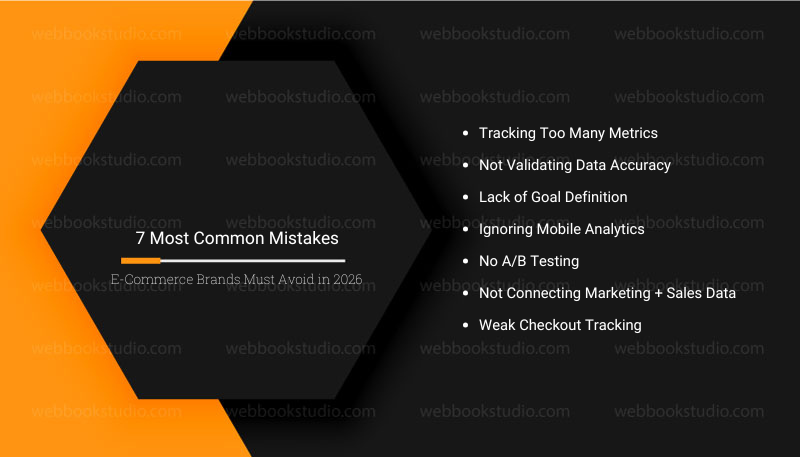
Even with powerful web analytics in digital marketing tools at their fingertips, many e-commerce businesses still struggle to achieve meaningful results, often because they fall into common, avoidable mistakes. Understanding these pitfalls is just as important as knowing which strategies to implement upcoming 2026.
1. Tracking Too Many Metrics
One of the biggest mistakes brands make is collecting excessive data for big data without knowing what to do with it. Instead of focusing on high-impact KPIs like conversion rate, cart abandonment, or sales performance, teams get lost in vanity metrics that offer no real value. Effective data analysis requires clarity, not volume.
2. Not Validating Data Accuracy
Incorrect or incomplete data tracking leads to poor decisions. If your eCommerce data analytics tools or Google Analytics properties are not configured correctly, every insight downstream becomes unreliable. Regular audits ensure that your analytics setup reflects real customer behavior across your eCommerce website and platforms.
3. Lack of Goal Definition
Without clear goals, even the best marketing campaigns and dashboards won’t reveal meaningful insights. Defining specific, measurable objectives is the foundation of a strong data-driven marketing strategy, and without them, optimization becomes guesswork.
4. Ignoring Mobile Analytics
With a massive portion of online shopping happening on mobile, ignoring mobile analytics is a costly oversight. User behavior, engagement patterns, and conversion paths differ significantly from desktop. Missing this data means missing opportunities to improve both user experience and e-commerce strategy performance.
5. No A/B Testing
Many e-commerce brands assume they know what customers want without testing it. Skipping A/B experiments prevents you from using real customer data to enhance UX design, product pages, checkout flows, and marketing messaging. Continuous testing is the engine of long-term optimization.
6. Not Connecting Marketing + Sales Data
When marketing and sales data live in separate systems, insights become fragmented. Integrating data across e-commerce platforms and advertising channels gives you a full picture of the customer journey, helping a data analyst identify which touchpoints truly drive revenue.
7. Weak Checkout Tracking
Checkout is where most revenue is won or lost. Yet many brands fail to properly track friction points, errors, and drop-offs. Without detailed checkout analytics, businesses can’t diagnose why users abandon carts or what prevents them from completing the final step in the buying process.
Unique Tips for Offering Web Analytics in Digital Marketing/E-Commerce Platform 2026.
In today’s competitive AI-digital world, understanding and applying analytics is no longer optional, and it’s the key to turning data into meaningful decisions that fuel sustainable e-commerce success.
| Unique Tip (2026-Ready) | What It Means / Implementation Logic | Why It Works / Monetization Example |
| AI-Powered Audits | Use AI tools like Optimizely to scan e-commerce sites for personalization gaps, missing recommendation models, and UX friction. | Clients pay a premium for future-proof insights. Example: $3K audit + roadmap, with 70% converting to monthly retainers. |
| Cookieless Strategy Consults | Build first-party data workflows using quizzes, interactive pop-ups, server-side tagging, and GDPR-compliant data capture. | Helps brands reduce dependency on cookies by up to 80%. Bundle with server-side tagging workshops to upsell. |
| Voice Analytics Specialization | Track smart assistant interactions (Alexa, Google Assistant) with custom events for voice search and voice commerce insights. | Unique 2026 niche with strong demand in the U.S./EU. Offer $1.5K analysis packages focusing on Alexa-driven traffic patterns. |
| Global Localization Analytics | Segment and analyze funnels by region to understand cultural behavior and UX differences. Adjust checkout, imagery, CTAs, and content accordingly. | Example: Modifying U.S. funnels for Middle East modesty filters increased conversions by 25%. Easy high-ROI service add-on. |
| Recurring Insight Retainers | Provide quarterly insights, dashboards, and optimization recommendations on autopilot. | Perfect for scaling: $500/month retainers justified through continuous value reports. Ideal for Upwork → agency growth. |
What is The 5 C’s Magic of E-Commerce?
The 5 C’s of e-commerce are Customer, Content, Convenience, Communication, and Community represent the foundation of a strong online business.
When paired with powerful web analytics in digital marketing, each of these pillars becomes smarter, more personalized, and more effective at driving conversions. Here’s how analytics enhances every C:
1. Customer: Understanding Who Buys and Why
At the heart of every e-commerce strategy is the customer. Through data analysis, segmentation, CLV modeling, and behavior tracking across your e-commerce website, analytics helps you understand:
- Who your most valuable customers are
- What products do they prefer
- How often do they purchase
- What motivates or stops them from buying
With accurate data tracking and insights from tools like Google Analytics, brands can personalize experiences, improve targeting, and build stronger data-driven customer journeys.
2. Content: Creating Experiences That Convert
Great and unique digital content production, product descriptions, images, videos, and landing pages are what convince shoppers to take action. E-commerce data analytics tools reveal:
- Which content pages drive the highest sales
- What product media users interact with most
- It’s where shoppers lose interest
- How content performs across different e-commerce platforms
With this knowledge, you can tailor your marketing campaigns, optimize product pages, and create high-performing content backed by real user behavior.
3. Convenience: Making the Buying Journey Frictionless
Convenience is a major driver of conversions. If your checkout is slow or your navigation is confusing, customers leave. Analytics shows you:
- Where users drop off
- How fast do pages load
- Whether mobile users face friction
- What elements cause cart abandonment
By combining data from heatmaps, funnel tracking, and behavior reports, teams can streamline navigation, improve mobile UX, and simplify checkout, key parts of a winning e-commerce strategy.
4. Communication: Delivering the Right Message at the Right Time
Effective communication builds trust and drives repeat purchases. Analytics helps you optimize communication by identifying:
- Which messages improve engagement
- What email or ad campaigns convert best
- That customer groups respond to specific offers
- When users are most likely to interact
Through data-driven personalization, brands can align messaging with user intent, ensuring consistent and impactful communication across all touchpoints.
5. Community: Building Loyalty and Advocacy
A strong community turns buyers into loyal advocates. Analytics helps measure and strengthen community interactions by tracking:
- Repeat purchase behavior
- Engagement with loyalty programs
- Social interactions and referral traffic
- Customer satisfaction trends
With the support of advanced predictive analytics and segmentation, businesses can identify high-value segments, reward loyal customers, and create marketing experiences that foster long-term brand affinity.
Conclusion: web analytics in digital marketing.
In today’s competitive digital landscape, web analytics in digital marketing is no longer a bonus; it’s the foundation of every high-performing e-commerce business.
By combining accurate data tracking, meaningful data analysis, and the right ecommerce data analytics tools, brands can finally move away from guesswork and build a truly data-driven growth engine.
If you’re optimizing your e-commerce website, refining marketing campaigns, or shaping a long-term e-commerce strategy. Analytics gives you the clarity and confidence to make decisions that directly support higher conversions and stronger sales.
As consumer behavior becomes more complex across different e-commerce platforms, advanced techniques like segmentation, CLV modeling, and predictive analytics help businesses uncover deeper insights and anticipate what customers need next.
This level of intelligence empowers marketers, business owners, and data analysts to improve user experience, reduce friction in the buying journey, and continuously enhance every touchpoint. Ultimately, the brands that win in e-commerce are the ones that treat data as a strategic asset, not an optional tool.
By applying the best practices covered in this guide, you’ll be able to create smarter e-commerce marketing strategies, eliminate hidden bottlenecks, and unlock sustainable growth powered by data, not assumptions. The path to scalable success is clear: understand your data, act on your insights, and let analytics guide every decision that shapes your digital future.
Get a more informative article: Ecommerce companies in the USA and their impact on traditional retail.
FAQs on Web Analytics in Digital Marketing.
1. What is the difference between web analytics and digital marketing analytics?
Web analytics focuses on website-specific data like traffic and behavior, while digital marketing analytics encompasses broader channels (social, email). Together, they optimize e-commerce holistically. The web provides the “how,” digital provides the “where from.”
2. How much does implementing web analytics cost for a small e-commerce business?
For starters, it’s free with Google Analytics. Advanced tools like Hotjar add $30-100/month. Total first-year under $1,200, with ROI in 3-6 months via 10-20% sales lifts.
3. Is web analytics compliant with 2026 privacy laws?
Yes, via first-party data and tools like GA4’s consent mode. Use IAB frameworks to maintain 85% accuracy post-cookies.
4. What free resources teach web analytics for beginners?
Google’s Skillshop (GA4 cert), HubSpot Academy, and Moz’s free guides. Dedicate 20 hours to the basics and apply them to a test site immediately.
5. How can web analytics improve email marketing for e-commerce?
By segmenting based on site behavior, cart abandoners get recovery emails, lifting opens by 35%. Track UTM links for full attribution.
6. Will AI replace web analysts by 2026?
No, AI automates 40% routine tasks, but human insight for strategy remains key. Upskill in AI tools to stay ahead.
7. What’s the average salary for a web analytics specialist in the U.S.?
$85,000-$110,000 in 2025, per Glassdoor. Globally, $50,000 average, higher in tech hubs like Singapore.